

Into The Wild South: The Falklands, South Georgia & Antarctica onboard Terra Nova Adventurer
All departures of this tripCRUISE ID # TERRANOVA_0494_FALKSOUTHG_MONT_USH_TNA_20271015
Ushuaia TO Ushuaia

Journey deep into the Southern Ocean at the very beginning of the Antarctic season, when the landscapes are at their wildest and spring is only just beginning to take hold.
Sailing from Montevideo, we first reach the remote Falkland Islands before crossing the wildlife-rich Scotia Sea to South Georgia. Here, snow still clings to the mountains as vast king penguin colonies gather along the coast and southern elephant seals arrive for one of nature's most dramatic breeding spectacles.
From South Georgia, we continue south towards Antarctica itself. Early in the season, sea ice can still shape our route, snow blankets the landscape and relatively few ships have ventured into these waters. It is Antarctica at its most pristine — and an expedition where conditions help write the story.
Suites & Fares
Itinerary
- Day 1October 15, 2027
Ushuaia, Argentina
At 55 degrees latitude south, Ushuaia (pronounced oo-swy-ah) is closer to the South Pole than to Argentina's northern border with Bolivia. It is the capital and tourism base for Tierra del Fuego, the island at the southernmost tip of Argentina.Although its stark physical beauty is striking, Tierra del Fuego's historical allure is based more on its mythical past than on rugged reality. The island was inhabited for 6,000 years by Yámana, Haush, Selk'nam, and Alakaluf Indians. But in 1902 Argentina, eager to populate Patagonia to bolster its territorial claims, moved to initiate an Ushuaian penal colony, establishing the permanent settlement of its most southern territories and, by implication, everything in between.When the prison closed in 1947, Ushuaia had a population of about 3,000, made up mainly of former inmates and prison staff. Today the Indians of Darwin's "missing link" theory are long gone—wiped out by diseases brought by settlers and by indifference to their plight—and the 60,000 residents of Ushuaia are hitching their star to tourism.The city rightly (if perhaps too loudly) promotes itself as the southernmost city in the world (Puerto Williams, a few miles south on the Chilean side of the Beagle Channel, is a small town). You can make your way to the tourism office to get your clichéd, but oh-so-necessary, "Southernmost City in the World" passport stamp. Ushuaia feels like a frontier boomtown, at heart still a rugged, weather-beaten fishing village, but exhibiting the frayed edges of a city that quadrupled in size in the '70s and '80s and just keeps growing. Unpaved portions of Ruta 3, the last stretch of the Pan-American Highway, which connects Alaska to Tierra del Fuego, are finally being paved. The summer months (December through March) draw more than 120,000 visitors, and dozens of cruise ships. The city is trying to extend those visits with events like March's Marathon at the End of the World and by increasing the gamut of winter activities buoyed by the excellent snow conditions.A terrific trail winds through the town up to the Martial Glacier, where a ski lift can help cut down a steep kilometer of your journey. The chaotic and contradictory urban landscape includes a handful of luxury hotels amid the concrete of public housing projects. Scores of "sled houses" (wooden shacks) sit precariously on upright piers, ready for speedy displacement to a different site. But there are also many small, picturesque homes with tiny, carefully tended gardens. Many of the newer homes are built in a Swiss-chalet style, reinforcing the idea that this is a town into which tourism has breathed new life. At the same time, the weather-worn pastel colors that dominate the town's landscape remind you that Ushuaia was once just a tiny fishing village, snuggled at the end of the Earth.As you stand on the banks of the Canal Beagle (Beagle Channel) near Ushuaia, the spirit of the farthest corner of the world takes hold. What stands out is the light: at sundown the landscape is cast in a subdued, sensual tone; everything feels closer, softer, and more human in dimension despite the vastness of the setting. The snowcapped mountains reflect the setting sun back onto a stream rolling into the channel, as nearby peaks echo their image—on a windless day—in the still waters.Above the city rise the last mountains of the Andean Cordillera, and just south and west of Ushuaia they finally vanish into the often-stormy sea. Snow whitens the peaks well into summer. Nature is the principal attraction here, with trekking, fishing, horseback riding, wildlife spotting, and sailing among the most rewarding activities, especially in the Parque Nacional Tierra del Fuego (Tierra del Fuego National Park).
- Day 2October 16, 2027
At Sea: Settling into Expedition Life
Our first full day at sea is an opportunity to settle into life aboard Terra Nova Adventurer.
Meet members of the expedition team, familiarise yourself with the ship and spend time on the outer decks as we travel south. Our lecture programme begins, introducing the wildlife, history and environments we'll encounter over the coming weeks.
- Day 3October 17, 2027
At Sea: Following the Seabirds South
We continue across the South Atlantic towards the Falkland Islands.
Keep watch from the decks for albatrosses, petrels and other seabirds beginning to accompany the ship. The expedition team will help identify the species we encounter and explain how these remarkable birds spend much of their lives travelling across the Southern Ocean.
- Day 4October 18, 2027
Preparing to Explore
Our final day of the crossing brings us closer to the Falkland Islands.
Presentations turn towards the wildlife and history of the archipelago as we prepare for our first expedition landings. Boots, equipment and Zodiacs are readied — tomorrow, the ship becomes our base for exploring ashore.
- Day 5October 19, 2027
Our First Expedition Landing
Welcome to the Falklands.
Weather and conditions will determine exactly where we explore, but today we hope to make our first landing and experience the islands' rugged landscapes and remarkable wildlife.
Penguins, seabirds and marine mammals all inhabit these remote shores, and we'll explore on foot and by Zodiac wherever the best opportunities present themselves.
- Day 6October 20, 2027
A Second Day of Exploration
We continue exploring the Falkland Islands, with our Captain and Expedition Leader choosing the day's programme according to weather, sea state and wildlife activity.
One day here can feel completely different from the next: windswept beaches, seabird colonies, sheltered bays and encounters with penguins may all form part of our experience.
Later, we turn east and begin our journey towards South Georgia.
- Day 7October 21, 2027
Into the Southern Ocean
The Falklands disappear behind us as we enter the Scotia Sea.
These aren't simply transit days. The Scotia Sea is one of the Southern Ocean's most biologically productive regions, supporting extraordinary numbers of seabirds and marine mammals.
Spend time outside with the expedition team watching for albatrosses, petrels and whales as we travel deeper into the Southern Ocean.
- Day 8October 22, 2027
Approaching South Georgia
Our journey east continues, and anticipation builds for South Georgia.
Lectures introduce the island's enormous wildlife populations, exploration history and extraordinary landscape. Outside, the wildlife watching continues.
Eventually, one of the Southern Ocean's great sights may appear on the horizon: the mountainous outline of South Georgia.
- Day 9October 23, 2027
First Encounters
Welcome to South Georgia.
Snow-covered mountains rise almost directly from the ocean, glaciers descend towards the coast and beaches can hold wildlife in astonishing numbers.
Today we hope to begin exploring this remarkable island by Zodiac and on foot, with our exact destination determined by conditions on arrival.
- Day 10October 24, 2027
Elephant Seal Season
October places us in South Georgia during one of its most dramatic natural events: southern elephant seal breeding season.
Huge males compete for territory while breeding beaches fill with seals. The sounds, scale and intensity can be extraordinary.
We'll seek the best opportunities to experience this spectacle while maintaining appropriate distances and following the guidance of our expedition team.
- Day 11October 25, 2027
The King Penguin Colonies
Today we hope to experience another of South Georgia's defining spectacles: its immense king penguin colonies.
Thousands upon thousands of birds can fill valleys and beaches beneath snow-covered mountains and glaciers. King penguins have an unusually long breeding cycle, so colonies may contain birds at different stages of breeding.
It's one of the great wildlife experiences of the Southern Ocean.
- Day 12October 26, 2027
History, Wildlife & One Final Adventure
Our final planned day around South Georgia gives us another opportunity to follow the conditions and wildlife.
Conditions permitting, we may also visit Grytviken, once a centre of the island's whaling industry and today closely associated with the story of Sir Ernest Shackleton.
Wherever the day takes us, we'll make the most of our remaining time before turning south towards Antarctica.
- Day 13October 27, 2027
South Towards Antarctica
We leave South Georgia behind and set a south-westerly course towards Antarctica.
The environment gradually changes around us. Temperatures fall, Antarctic seabirds become increasingly common and we begin watching for our first icebergs.
Lectures turn towards Antarctica as the expedition team prepares us for the next chapter of our journey.
- Day 14October 28, 2027
Following the Ice South
Today we travel deeper into Antarctic waters.
At this early stage of the season, sea ice may play an important role in determining our route. The Captain and Expedition Leader will monitor weather, ice information and conditions as we approach Elephant Island, then the South Shetland Islands and Antarctic Peninsula.
Then comes the moment everyone has been waiting for: our first sight of Antarctica.
- Day 15October 29, 2027
First Antarctic Exploration
Welcome to Antarctica.
Winter has only recently loosened its grip. Mountains can remain covered in deep snow, bays may hold extensive sea ice and the landscape has the pristine character of the very beginning of the expedition season.
Conditions permitting, we'll begin exploring by Zodiac and on foot.
- Day 16October 30, 2027
Among Ice & Penguins
Another day of exploration begins, but there is deliberately no fixed programme.
We may navigate among sculpted icebergs, cruise beneath glaciers or go ashore near a penguin colony. Early-season snow and ice can transform familiar Antarctic locations into completely different landscapes.
Where conditions permit, opportunities may also include kayaking, snowshoeing, hiking and photography.
- Day 17October 31, 2027
Following the Best Conditions
By now, the rhythm of expedition travel has taken over.
The Captain and Expedition Leader will assess the weather, wildlife and ice before choosing where today's adventure takes us.
Perhaps a sheltered bay offers spectacular Zodiac cruising. Perhaps ice conditions open a route towards an unexpected landing. Or perhaps wildlife changes our plans entirely.
That's the beauty of expedition travel.
- Day 18November 01, 2027
One More Day in the Wild South
Our final planned day of Antarctic exploration gives us another opportunity to make the most of this extraordinary early-season environment.
We'll follow the conditions and seek out the best experience available — whether that's ashore, among the ice by Zodiac, kayaking or simply stopping to watch wildlife.
Eventually, we turn north and begin our journey towards South America.
- Day 19November 02, 2027
North Across the Drake
We begin our northbound crossing of the legendary Drake Passage.
After days packed with exploration, today offers time to slow down and absorb what we've experienced — from elephant seal breeding beaches and king penguin colonies to the snow and ice of early-season Antarctica.
- Day 20November 03, 2027
Ushuaia, Argentina
At 55 degrees latitude south, Ushuaia (pronounced oo-swy-ah) is closer to the South Pole than to Argentina's northern border with Bolivia. It is the capital and tourism base for Tierra del Fuego, the island at the southernmost tip of Argentina.Although its stark physical beauty is striking, Tierra del Fuego's historical allure is based more on its mythical past than on rugged reality. The island was inhabited for 6,000 years by Yámana, Haush, Selk'nam, and Alakaluf Indians. But in 1902 Argentina, eager to populate Patagonia to bolster its territorial claims, moved to initiate an Ushuaian penal colony, establishing the permanent settlement of its most southern territories and, by implication, everything in between.When the prison closed in 1947, Ushuaia had a population of about 3,000, made up mainly of former inmates and prison staff. Today the Indians of Darwin's "missing link" theory are long gone—wiped out by diseases brought by settlers and by indifference to their plight—and the 60,000 residents of Ushuaia are hitching their star to tourism.The city rightly (if perhaps too loudly) promotes itself as the southernmost city in the world (Puerto Williams, a few miles south on the Chilean side of the Beagle Channel, is a small town). You can make your way to the tourism office to get your clichéd, but oh-so-necessary, "Southernmost City in the World" passport stamp. Ushuaia feels like a frontier boomtown, at heart still a rugged, weather-beaten fishing village, but exhibiting the frayed edges of a city that quadrupled in size in the '70s and '80s and just keeps growing. Unpaved portions of Ruta 3, the last stretch of the Pan-American Highway, which connects Alaska to Tierra del Fuego, are finally being paved. The summer months (December through March) draw more than 120,000 visitors, and dozens of cruise ships. The city is trying to extend those visits with events like March's Marathon at the End of the World and by increasing the gamut of winter activities buoyed by the excellent snow conditions.A terrific trail winds through the town up to the Martial Glacier, where a ski lift can help cut down a steep kilometer of your journey. The chaotic and contradictory urban landscape includes a handful of luxury hotels amid the concrete of public housing projects. Scores of "sled houses" (wooden shacks) sit precariously on upright piers, ready for speedy displacement to a different site. But there are also many small, picturesque homes with tiny, carefully tended gardens. Many of the newer homes are built in a Swiss-chalet style, reinforcing the idea that this is a town into which tourism has breathed new life. At the same time, the weather-worn pastel colors that dominate the town's landscape remind you that Ushuaia was once just a tiny fishing village, snuggled at the end of the Earth.As you stand on the banks of the Canal Beagle (Beagle Channel) near Ushuaia, the spirit of the farthest corner of the world takes hold. What stands out is the light: at sundown the landscape is cast in a subdued, sensual tone; everything feels closer, softer, and more human in dimension despite the vastness of the setting. The snowcapped mountains reflect the setting sun back onto a stream rolling into the channel, as nearby peaks echo their image—on a windless day—in the still waters.Above the city rise the last mountains of the Andean Cordillera, and just south and west of Ushuaia they finally vanish into the often-stormy sea. Snow whitens the peaks well into summer. Nature is the principal attraction here, with trekking, fishing, horseback riding, wildlife spotting, and sailing among the most rewarding activities, especially in the Parque Nacional Tierra del Fuego (Tierra del Fuego National Park).
- Day 21November 04, 2027
Ushuaia, Argentina
At 55 degrees latitude south, Ushuaia (pronounced oo-swy-ah) is closer to the South Pole than to Argentina's northern border with Bolivia. It is the capital and tourism base for Tierra del Fuego, the island at the southernmost tip of Argentina.Although its stark physical beauty is striking, Tierra del Fuego's historical allure is based more on its mythical past than on rugged reality. The island was inhabited for 6,000 years by Yámana, Haush, Selk'nam, and Alakaluf Indians. But in 1902 Argentina, eager to populate Patagonia to bolster its territorial claims, moved to initiate an Ushuaian penal colony, establishing the permanent settlement of its most southern territories and, by implication, everything in between.When the prison closed in 1947, Ushuaia had a population of about 3,000, made up mainly of former inmates and prison staff. Today the Indians of Darwin's "missing link" theory are long gone—wiped out by diseases brought by settlers and by indifference to their plight—and the 60,000 residents of Ushuaia are hitching their star to tourism.The city rightly (if perhaps too loudly) promotes itself as the southernmost city in the world (Puerto Williams, a few miles south on the Chilean side of the Beagle Channel, is a small town). You can make your way to the tourism office to get your clichéd, but oh-so-necessary, "Southernmost City in the World" passport stamp. Ushuaia feels like a frontier boomtown, at heart still a rugged, weather-beaten fishing village, but exhibiting the frayed edges of a city that quadrupled in size in the '70s and '80s and just keeps growing. Unpaved portions of Ruta 3, the last stretch of the Pan-American Highway, which connects Alaska to Tierra del Fuego, are finally being paved. The summer months (December through March) draw more than 120,000 visitors, and dozens of cruise ships. The city is trying to extend those visits with events like March's Marathon at the End of the World and by increasing the gamut of winter activities buoyed by the excellent snow conditions.A terrific trail winds through the town up to the Martial Glacier, where a ski lift can help cut down a steep kilometer of your journey. The chaotic and contradictory urban landscape includes a handful of luxury hotels amid the concrete of public housing projects. Scores of "sled houses" (wooden shacks) sit precariously on upright piers, ready for speedy displacement to a different site. But there are also many small, picturesque homes with tiny, carefully tended gardens. Many of the newer homes are built in a Swiss-chalet style, reinforcing the idea that this is a town into which tourism has breathed new life. At the same time, the weather-worn pastel colors that dominate the town's landscape remind you that Ushuaia was once just a tiny fishing village, snuggled at the end of the Earth.As you stand on the banks of the Canal Beagle (Beagle Channel) near Ushuaia, the spirit of the farthest corner of the world takes hold. What stands out is the light: at sundown the landscape is cast in a subdued, sensual tone; everything feels closer, softer, and more human in dimension despite the vastness of the setting. The snowcapped mountains reflect the setting sun back onto a stream rolling into the channel, as nearby peaks echo their image—on a windless day—in the still waters.Above the city rise the last mountains of the Andean Cordillera, and just south and west of Ushuaia they finally vanish into the often-stormy sea. Snow whitens the peaks well into summer. Nature is the principal attraction here, with trekking, fishing, horseback riding, wildlife spotting, and sailing among the most rewarding activities, especially in the Parque Nacional Tierra del Fuego (Tierra del Fuego National Park).
- Day 22November 05, 2027
Day at Sea
About the Ship
Terra Nova Adventurer

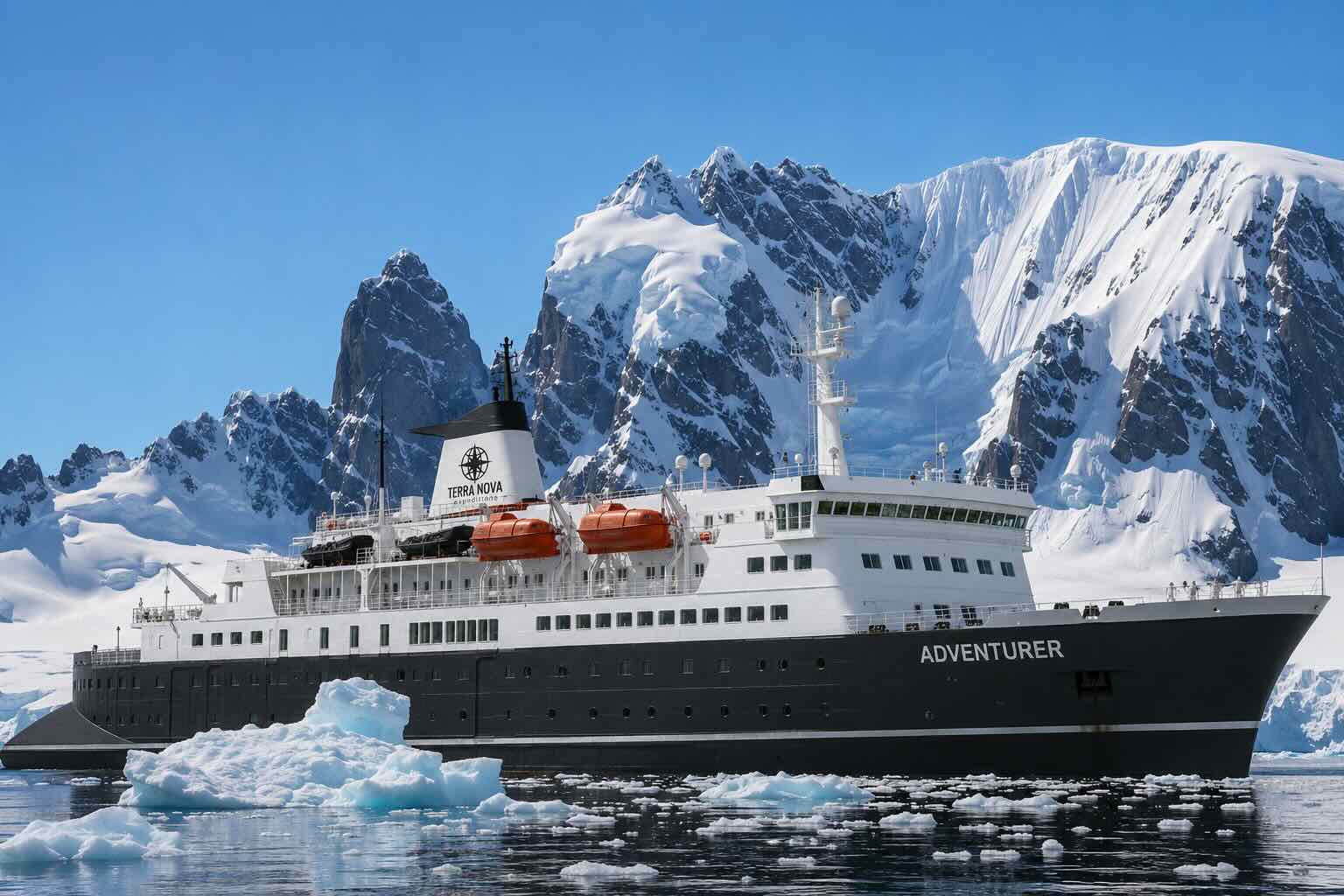
- 99Guests
- 55Cabins
- 1972Launched
- 105 mLength
All ship facts
- Crew
- 60
- Decks
- 6
- Gross tonnage
- 3960
- Speed
- 17 kts
- Width
- 18 m
- Currency on board
- USD
- Language
- English