

CRUISE ID # HERITAGEHA270201
Queenstown TO Queenstown
Suites & Fares
Itinerary
- Day 1February 01, 2027
Queenstown, New Zealand
Arrive at Queenstown, New Zealand’s world famous alpine resort town. Guests should make their way to the designated hotel where we will spend the first night of the expedition. This evening there will be an informal get-together at the hotel for dinner; an excellent opportunity to meet fellow adventurers on your voyage and some of our expedition team. Guests on our February 2028 departure will spend the first night in Invercargill, make their way to the designated hotel, or join our 3pm or 6pm Queenstown transfer from the assigned meeting point to Invercargill. - Day 2February 02, 2027
Bluff, New Zealand
The most southernmost town in New Zealand, Bluff (or The Bluff as it is locally known) is perhaps the most European of all the settlements in the country. Called Campbelltown until 1917, the city was officially renamed after the 265 meter conical hill that towers above it. One of the farthest corners of the British Empire, the inaugural Royal Tour of New Zealand by Queen Elizabeth II and Prince Philip, the Duke of Edinburgh, concluded at Bluff in January 1954. Nowadays however, it is the Bluff oysters that are the stars of the show. Reputed to be the best in the world, these local heroes are what have really put Bluff on the map and are celebrated every May with a lively festival honouring Ostrea chilensis (that’s Latin for Bluff oyster). But gastronomy aside (and it is mostly oyster related), Bluff offers the adventurous traveller much in the way activity. Gateway to Stewart Island, day trippers here might enjoy hopping on the ferry for the hour long trip to Stewart Island, or New Zealand’s third island. Unspoilt, tranquil and stunning, Stewart Island is a showcase for New Zealand’s undiscovered tourism spots due to its privileged (yet remote) position in the world. However, for those who wish to stay on the mainland, the Bluff Maritime Museum is a “must visit” for anyone travelling along the Southern Scenic Route, with fascinating historical information about the many early shipwrecks in these challenging southern waters and coastlines. The comprehensive network of walking tracks will delight the ornithologists amongst you – just don’t forget your binoculars!
- Day 3February 03, 2027
Snares Islands, New Zealand
The Snares Islands, also known as ‘The Snares’ are the northernmost of New Zealand's subantarctic islands. The islands are totally uninhabited and land mammals were never introduced on the islands, so it is only inhabited by sea mammals, birds and flora. The area is among one of five subantarctic island groups forming the New Zealand Subantarctic Islands, designated as a World Heritage Site by UNESCO.
- Day 4February 04, 2027
Enderby Island, New Zealand
Enderby Island is the second largest island in the archipelago which is brimming with a magnificent flora and fauna environment. The island has become well known for being home to the rare yellow-eyed penguin and it is further the primary breeding location for the New Zealand Sra Lion. Enjoy a guided tour of the Northern Cliffs track and if you’re lucky, spend some time observing the sea lion colony.
- Day 5February 05, 2027
Day at Sea
- Day 6February 06, 2027
Macquarie Island, Tasmania, Australia
Macquarie Island is a UNESCO World Heritage Site due to its major geoconservation significance. It is the only island in the world that is entirely composed of oceanic crust and rocks from the mantel. The unique diversity of the island makes it a truly remarkable place to visit. Sand Bay is located on the east coast where you will find Royal and King Penguin rookeries as well as Southern Elephant Seals, and if the weather permits, you will have the opportunity to get closer on a Zodiac®.
- Day 7February 07, 2027
Macquarie Island, Tasmania, Australia
Macquarie Island is a UNESCO World Heritage Site due to its major geoconservation significance. It is the only island in the world that is entirely composed of oceanic crust and rocks from the mantel. The unique diversity of the island makes it a truly remarkable place to visit. Sand Bay is located on the east coast where you will find Royal and King Penguin rookeries as well as Southern Elephant Seals, and if the weather permits, you will have the opportunity to get closer on a Zodiac®.
- Day 8February 08, 2027
Day at Sea
- Day 9February 09, 2027
Day at Sea
- Day 10February 10, 2027
Day at Sea
- Day 11February 11, 2027
Cruising the Ross Sea
During our time in the Ross Sea region, we will visit the highlights of Antarctica’s most historic region. Due to the unpredictable nature of ice and weather conditions, a day-by-day itinerary is not possible. The Captain and Expedition Leader will assess daily conditions and take advantage of every opportunity to make landings and explore in the Zodiacs. Our programme emphasises wildlife viewing, key scientific bases and historic sites, as well as the spectacular scenery of the coastal terrain, the glaciers and icebergs of the Ross Sea. Whilst specific landings cannot be guaranteed, we hope to visit the following: Cape Adare Cape Adare’s bold headland and the Downshire Cliffs greet us as we approach Cape Adare – ice conditions permitting – at the tip of the Ross Sea, the site of the largest Adelie Penguin rookery in Antarctica. Blanketing the large, flat spit which forms the cape is the huge rookery which now, at the height of summer, numbers over one million birds – an absolutely staggering sight. You will never forget your first experiences in a ceaselessly active and noisy ‘penguin city’, where the dapper inhabitants show no fear of their strange visitors. Our naturalists will point out various aspects of their lifestyle and, by standing quietly, one may observe the often comical behaviour of the penguins, courtship displays, feeding ever-hungry chicks, territorial disputes and the pilfering of nest material. Surrounded by a sea of penguins we will find Borchgrevink’s Hut, the oldest in Antarctica, an overwintering shelter for the first expedition to the continent in 1899. It is a fascinating relic of the ‘Heroic Age’ of Antarctic exploration and we are able to inspect the interior, which still contains artefacts of the early explorers. One thousand feet up in the hills behind Cape Adare is the oldest grave in Antarctica, that of 22-year-old Nicolai Hansen, a member of Borchgrevink’s expedition. Cape Hallett The enormous Admiralty Range heralds our arrival at Cape Hallett. The scenery here is wild and spectacular; mountains rise up towering out of the sea to over 4,000-metres high and giant glaciers course down from the interior to the water’s edge. We land next to the site of the abandoned American/New Zealand base, home to large numbers of Adelie Penguins and Weddell Seals. Franklin Island This rugged island, deep in the Ross Sea, is home to a large Adelie Penguin colony and other nesting seabirds. We will attempt a Zodiac landing near the rookery as well as exploring the coastline. If a landing is achieved and weather conditions are suitable there will be an opportunity to explore this remarkable island. Possession Islands These small, rugged and rarely visited islands lie off the shore of Cape Hallett. An Adelie Penguin rookery, numbering tens of thousands of birds, blankets Foyn Island. Observe their busy and sometimes humorous activities, with the Admiralty Mountains forming a superb backdrop across the water. Ross Ice Shelf The largest ice shelf in Antarctica, the Ross Ice Shelf is also the world’s largest body of floating ice. A natural ice barrier, at times it creates hazardous weather conditions, with sheets of snow blown at gale force by the katabatic winds coming off the polar ice cap. Just 1,287 kilometres from the South Pole, this daunting spectacle prevented early Antarctic explorers from venturing further south. From the Ross Ice Shelf we cruise eastward along the shelf front, with its spectacular 30-metre high ice cliffs, which sometimes calve tabular icebergs. Ross Island – Mount Erebus/Cape Bird/Shackleton’s Hut/Scott’s Hut At the base of the Ross Sea we arrive at Ross Island, dominated by the 3,794-metre high volcano, Mt Erebus. The New Zealand Antarctica programme maintains a field station at Cape Bird, where scientists study many aspects of the region’s natural history, including the large Adelie Penguin colony. At Cape Royds we visit Sir Ernest Shackleton’s hut, built during the Nimrod polar expedition of 1907-1909. Lectures explain many facets of Shackleton’s amazing expeditions. He was possibly one of the greatest, and certainly one of the most heroic of the Antarctic explorers. Though the legendary explorers are long gone, the area around the hut is far from deserted, having been reclaimed by the original inhabitants of the area – thousands of Adelie Penguins in the world’s southernmost penguin rookery. Also found on Ross Island is Cape Evans, the historic site of Captain Scott’s second hut, erected in 1911 and beautifully preserved by the Antarctic Heritage Trust. It stands as testimony to the rigours faced by pioneering explorers. Inside the hut we will witness the living conditions almost exactly as they were when Scott, Wilson and Ponting occupied these quarters. Behind the hut, Mt Erebus looms above with its plume of white smoke spiralling up from the still-active inferno in its bowels. McMurdo and Scott Base (including Scott’s Discovery Hut) These are always on our wish list but ice, weather and operational requirements for the National Programs icebreaker activities sometimes prevent us from visiting, especially on the January expedition. Our February expedition is generally more successful but not guaranteed. Terra Nova Bay Stazione Mario Zucchelli, an Italian summer research station, is an interesting shipping container construction. The friendly scientists and support staff here are always most hospitable and enjoy showing us around their lonely but beautiful home. The Italians conduct many streams of scientific research and also claim to have the best ‘espresso’ in Antarctica! Nearby is the German base, Gondwana Station, which is used occasionally and the South Korean station, Jang Bogo and on Inexpressible Island, is China’s fifth Antarctic base, Qinling Station. - Day 12February 12, 2027
Cruising the Ross Sea
During our time in the Ross Sea region, we will visit the highlights of Antarctica’s most historic region. Due to the unpredictable nature of ice and weather conditions, a day-by-day itinerary is not possible. The Captain and Expedition Leader will assess daily conditions and take advantage of every opportunity to make landings and explore in the Zodiacs. Our programme emphasises wildlife viewing, key scientific bases and historic sites, as well as the spectacular scenery of the coastal terrain, the glaciers and icebergs of the Ross Sea. Whilst specific landings cannot be guaranteed, we hope to visit the following: Cape Adare Cape Adare’s bold headland and the Downshire Cliffs greet us as we approach Cape Adare – ice conditions permitting – at the tip of the Ross Sea, the site of the largest Adelie Penguin rookery in Antarctica. Blanketing the large, flat spit which forms the cape is the huge rookery which now, at the height of summer, numbers over one million birds – an absolutely staggering sight. You will never forget your first experiences in a ceaselessly active and noisy ‘penguin city’, where the dapper inhabitants show no fear of their strange visitors. Our naturalists will point out various aspects of their lifestyle and, by standing quietly, one may observe the often comical behaviour of the penguins, courtship displays, feeding ever-hungry chicks, territorial disputes and the pilfering of nest material. Surrounded by a sea of penguins we will find Borchgrevink’s Hut, the oldest in Antarctica, an overwintering shelter for the first expedition to the continent in 1899. It is a fascinating relic of the ‘Heroic Age’ of Antarctic exploration and we are able to inspect the interior, which still contains artefacts of the early explorers. One thousand feet up in the hills behind Cape Adare is the oldest grave in Antarctica, that of 22-year-old Nicolai Hansen, a member of Borchgrevink’s expedition. Cape Hallett The enormous Admiralty Range heralds our arrival at Cape Hallett. The scenery here is wild and spectacular; mountains rise up towering out of the sea to over 4,000-metres high and giant glaciers course down from the interior to the water’s edge. We land next to the site of the abandoned American/New Zealand base, home to large numbers of Adelie Penguins and Weddell Seals. Franklin Island This rugged island, deep in the Ross Sea, is home to a large Adelie Penguin colony and other nesting seabirds. We will attempt a Zodiac landing near the rookery as well as exploring the coastline. If a landing is achieved and weather conditions are suitable there will be an opportunity to explore this remarkable island. Possession Islands These small, rugged and rarely visited islands lie off the shore of Cape Hallett. An Adelie Penguin rookery, numbering tens of thousands of birds, blankets Foyn Island. Observe their busy and sometimes humorous activities, with the Admiralty Mountains forming a superb backdrop across the water. Ross Ice Shelf The largest ice shelf in Antarctica, the Ross Ice Shelf is also the world’s largest body of floating ice. A natural ice barrier, at times it creates hazardous weather conditions, with sheets of snow blown at gale force by the katabatic winds coming off the polar ice cap. Just 1,287 kilometres from the South Pole, this daunting spectacle prevented early Antarctic explorers from venturing further south. From the Ross Ice Shelf we cruise eastward along the shelf front, with its spectacular 30-metre high ice cliffs, which sometimes calve tabular icebergs. Ross Island – Mount Erebus/Cape Bird/Shackleton’s Hut/Scott’s Hut At the base of the Ross Sea we arrive at Ross Island, dominated by the 3,794-metre high volcano, Mt Erebus. The New Zealand Antarctica programme maintains a field station at Cape Bird, where scientists study many aspects of the region’s natural history, including the large Adelie Penguin colony. At Cape Royds we visit Sir Ernest Shackleton’s hut, built during the Nimrod polar expedition of 1907-1909. Lectures explain many facets of Shackleton’s amazing expeditions. He was possibly one of the greatest, and certainly one of the most heroic of the Antarctic explorers. Though the legendary explorers are long gone, the area around the hut is far from deserted, having been reclaimed by the original inhabitants of the area – thousands of Adelie Penguins in the world’s southernmost penguin rookery. Also found on Ross Island is Cape Evans, the historic site of Captain Scott’s second hut, erected in 1911 and beautifully preserved by the Antarctic Heritage Trust. It stands as testimony to the rigours faced by pioneering explorers. Inside the hut we will witness the living conditions almost exactly as they were when Scott, Wilson and Ponting occupied these quarters. Behind the hut, Mt Erebus looms above with its plume of white smoke spiralling up from the still-active inferno in its bowels. McMurdo and Scott Base (including Scott’s Discovery Hut) These are always on our wish list but ice, weather and operational requirements for the National Programs icebreaker activities sometimes prevent us from visiting, especially on the January expedition. Our February expedition is generally more successful but not guaranteed. Terra Nova Bay Stazione Mario Zucchelli, an Italian summer research station, is an interesting shipping container construction. The friendly scientists and support staff here are always most hospitable and enjoy showing us around their lonely but beautiful home. The Italians conduct many streams of scientific research and also claim to have the best ‘espresso’ in Antarctica! Nearby is the German base, Gondwana Station, which is used occasionally and the South Korean station, Jang Bogo and on Inexpressible Island, is China’s fifth Antarctic base, Qinling Station. - Day 13February 13, 2027
Cruising the Ross Sea
During our time in the Ross Sea region, we will visit the highlights of Antarctica’s most historic region. Due to the unpredictable nature of ice and weather conditions, a day-by-day itinerary is not possible. The Captain and Expedition Leader will assess daily conditions and take advantage of every opportunity to make landings and explore in the Zodiacs. Our programme emphasises wildlife viewing, key scientific bases and historic sites, as well as the spectacular scenery of the coastal terrain, the glaciers and icebergs of the Ross Sea. Whilst specific landings cannot be guaranteed, we hope to visit the following: Cape Adare Cape Adare’s bold headland and the Downshire Cliffs greet us as we approach Cape Adare – ice conditions permitting – at the tip of the Ross Sea, the site of the largest Adelie Penguin rookery in Antarctica. Blanketing the large, flat spit which forms the cape is the huge rookery which now, at the height of summer, numbers over one million birds – an absolutely staggering sight. You will never forget your first experiences in a ceaselessly active and noisy ‘penguin city’, where the dapper inhabitants show no fear of their strange visitors. Our naturalists will point out various aspects of their lifestyle and, by standing quietly, one may observe the often comical behaviour of the penguins, courtship displays, feeding ever-hungry chicks, territorial disputes and the pilfering of nest material. Surrounded by a sea of penguins we will find Borchgrevink’s Hut, the oldest in Antarctica, an overwintering shelter for the first expedition to the continent in 1899. It is a fascinating relic of the ‘Heroic Age’ of Antarctic exploration and we are able to inspect the interior, which still contains artefacts of the early explorers. One thousand feet up in the hills behind Cape Adare is the oldest grave in Antarctica, that of 22-year-old Nicolai Hansen, a member of Borchgrevink’s expedition. Cape Hallett The enormous Admiralty Range heralds our arrival at Cape Hallett. The scenery here is wild and spectacular; mountains rise up towering out of the sea to over 4,000-metres high and giant glaciers course down from the interior to the water’s edge. We land next to the site of the abandoned American/New Zealand base, home to large numbers of Adelie Penguins and Weddell Seals. Franklin Island This rugged island, deep in the Ross Sea, is home to a large Adelie Penguin colony and other nesting seabirds. We will attempt a Zodiac landing near the rookery as well as exploring the coastline. If a landing is achieved and weather conditions are suitable there will be an opportunity to explore this remarkable island. Possession Islands These small, rugged and rarely visited islands lie off the shore of Cape Hallett. An Adelie Penguin rookery, numbering tens of thousands of birds, blankets Foyn Island. Observe their busy and sometimes humorous activities, with the Admiralty Mountains forming a superb backdrop across the water. Ross Ice Shelf The largest ice shelf in Antarctica, the Ross Ice Shelf is also the world’s largest body of floating ice. A natural ice barrier, at times it creates hazardous weather conditions, with sheets of snow blown at gale force by the katabatic winds coming off the polar ice cap. Just 1,287 kilometres from the South Pole, this daunting spectacle prevented early Antarctic explorers from venturing further south. From the Ross Ice Shelf we cruise eastward along the shelf front, with its spectacular 30-metre high ice cliffs, which sometimes calve tabular icebergs. Ross Island – Mount Erebus/Cape Bird/Shackleton’s Hut/Scott’s Hut At the base of the Ross Sea we arrive at Ross Island, dominated by the 3,794-metre high volcano, Mt Erebus. The New Zealand Antarctica programme maintains a field station at Cape Bird, where scientists study many aspects of the region’s natural history, including the large Adelie Penguin colony. At Cape Royds we visit Sir Ernest Shackleton’s hut, built during the Nimrod polar expedition of 1907-1909. Lectures explain many facets of Shackleton’s amazing expeditions. He was possibly one of the greatest, and certainly one of the most heroic of the Antarctic explorers. Though the legendary explorers are long gone, the area around the hut is far from deserted, having been reclaimed by the original inhabitants of the area – thousands of Adelie Penguins in the world’s southernmost penguin rookery. Also found on Ross Island is Cape Evans, the historic site of Captain Scott’s second hut, erected in 1911 and beautifully preserved by the Antarctic Heritage Trust. It stands as testimony to the rigours faced by pioneering explorers. Inside the hut we will witness the living conditions almost exactly as they were when Scott, Wilson and Ponting occupied these quarters. Behind the hut, Mt Erebus looms above with its plume of white smoke spiralling up from the still-active inferno in its bowels. McMurdo and Scott Base (including Scott’s Discovery Hut) These are always on our wish list but ice, weather and operational requirements for the National Programs icebreaker activities sometimes prevent us from visiting, especially on the January expedition. Our February expedition is generally more successful but not guaranteed. Terra Nova Bay Stazione Mario Zucchelli, an Italian summer research station, is an interesting shipping container construction. The friendly scientists and support staff here are always most hospitable and enjoy showing us around their lonely but beautiful home. The Italians conduct many streams of scientific research and also claim to have the best ‘espresso’ in Antarctica! Nearby is the German base, Gondwana Station, which is used occasionally and the South Korean station, Jang Bogo and on Inexpressible Island, is China’s fifth Antarctic base, Qinling Station. - Day 14February 14, 2027
Cruising the Ross Sea
During our time in the Ross Sea region, we will visit the highlights of Antarctica’s most historic region. Due to the unpredictable nature of ice and weather conditions, a day-by-day itinerary is not possible. The Captain and Expedition Leader will assess daily conditions and take advantage of every opportunity to make landings and explore in the Zodiacs. Our programme emphasises wildlife viewing, key scientific bases and historic sites, as well as the spectacular scenery of the coastal terrain, the glaciers and icebergs of the Ross Sea. Whilst specific landings cannot be guaranteed, we hope to visit the following: Cape Adare Cape Adare’s bold headland and the Downshire Cliffs greet us as we approach Cape Adare – ice conditions permitting – at the tip of the Ross Sea, the site of the largest Adelie Penguin rookery in Antarctica. Blanketing the large, flat spit which forms the cape is the huge rookery which now, at the height of summer, numbers over one million birds – an absolutely staggering sight. You will never forget your first experiences in a ceaselessly active and noisy ‘penguin city’, where the dapper inhabitants show no fear of their strange visitors. Our naturalists will point out various aspects of their lifestyle and, by standing quietly, one may observe the often comical behaviour of the penguins, courtship displays, feeding ever-hungry chicks, territorial disputes and the pilfering of nest material. Surrounded by a sea of penguins we will find Borchgrevink’s Hut, the oldest in Antarctica, an overwintering shelter for the first expedition to the continent in 1899. It is a fascinating relic of the ‘Heroic Age’ of Antarctic exploration and we are able to inspect the interior, which still contains artefacts of the early explorers. One thousand feet up in the hills behind Cape Adare is the oldest grave in Antarctica, that of 22-year-old Nicolai Hansen, a member of Borchgrevink’s expedition. Cape Hallett The enormous Admiralty Range heralds our arrival at Cape Hallett. The scenery here is wild and spectacular; mountains rise up towering out of the sea to over 4,000-metres high and giant glaciers course down from the interior to the water’s edge. We land next to the site of the abandoned American/New Zealand base, home to large numbers of Adelie Penguins and Weddell Seals. Franklin Island This rugged island, deep in the Ross Sea, is home to a large Adelie Penguin colony and other nesting seabirds. We will attempt a Zodiac landing near the rookery as well as exploring the coastline. If a landing is achieved and weather conditions are suitable there will be an opportunity to explore this remarkable island. Possession Islands These small, rugged and rarely visited islands lie off the shore of Cape Hallett. An Adelie Penguin rookery, numbering tens of thousands of birds, blankets Foyn Island. Observe their busy and sometimes humorous activities, with the Admiralty Mountains forming a superb backdrop across the water. Ross Ice Shelf The largest ice shelf in Antarctica, the Ross Ice Shelf is also the world’s largest body of floating ice. A natural ice barrier, at times it creates hazardous weather conditions, with sheets of snow blown at gale force by the katabatic winds coming off the polar ice cap. Just 1,287 kilometres from the South Pole, this daunting spectacle prevented early Antarctic explorers from venturing further south. From the Ross Ice Shelf we cruise eastward along the shelf front, with its spectacular 30-metre high ice cliffs, which sometimes calve tabular icebergs. Ross Island – Mount Erebus/Cape Bird/Shackleton’s Hut/Scott’s Hut At the base of the Ross Sea we arrive at Ross Island, dominated by the 3,794-metre high volcano, Mt Erebus. The New Zealand Antarctica programme maintains a field station at Cape Bird, where scientists study many aspects of the region’s natural history, including the large Adelie Penguin colony. At Cape Royds we visit Sir Ernest Shackleton’s hut, built during the Nimrod polar expedition of 1907-1909. Lectures explain many facets of Shackleton’s amazing expeditions. He was possibly one of the greatest, and certainly one of the most heroic of the Antarctic explorers. Though the legendary explorers are long gone, the area around the hut is far from deserted, having been reclaimed by the original inhabitants of the area – thousands of Adelie Penguins in the world’s southernmost penguin rookery. Also found on Ross Island is Cape Evans, the historic site of Captain Scott’s second hut, erected in 1911 and beautifully preserved by the Antarctic Heritage Trust. It stands as testimony to the rigours faced by pioneering explorers. Inside the hut we will witness the living conditions almost exactly as they were when Scott, Wilson and Ponting occupied these quarters. Behind the hut, Mt Erebus looms above with its plume of white smoke spiralling up from the still-active inferno in its bowels. McMurdo and Scott Base (including Scott’s Discovery Hut) These are always on our wish list but ice, weather and operational requirements for the National Programs icebreaker activities sometimes prevent us from visiting, especially on the January expedition. Our February expedition is generally more successful but not guaranteed. Terra Nova Bay Stazione Mario Zucchelli, an Italian summer research station, is an interesting shipping container construction. The friendly scientists and support staff here are always most hospitable and enjoy showing us around their lonely but beautiful home. The Italians conduct many streams of scientific research and also claim to have the best ‘espresso’ in Antarctica! Nearby is the German base, Gondwana Station, which is used occasionally and the South Korean station, Jang Bogo and on Inexpressible Island, is China’s fifth Antarctic base, Qinling Station. - Day 15February 15, 2027
Cruising the Ross Sea
During our time in the Ross Sea region, we will visit the highlights of Antarctica’s most historic region. Due to the unpredictable nature of ice and weather conditions, a day-by-day itinerary is not possible. The Captain and Expedition Leader will assess daily conditions and take advantage of every opportunity to make landings and explore in the Zodiacs. Our programme emphasises wildlife viewing, key scientific bases and historic sites, as well as the spectacular scenery of the coastal terrain, the glaciers and icebergs of the Ross Sea. Whilst specific landings cannot be guaranteed, we hope to visit the following: Cape Adare Cape Adare’s bold headland and the Downshire Cliffs greet us as we approach Cape Adare – ice conditions permitting – at the tip of the Ross Sea, the site of the largest Adelie Penguin rookery in Antarctica. Blanketing the large, flat spit which forms the cape is the huge rookery which now, at the height of summer, numbers over one million birds – an absolutely staggering sight. You will never forget your first experiences in a ceaselessly active and noisy ‘penguin city’, where the dapper inhabitants show no fear of their strange visitors. Our naturalists will point out various aspects of their lifestyle and, by standing quietly, one may observe the often comical behaviour of the penguins, courtship displays, feeding ever-hungry chicks, territorial disputes and the pilfering of nest material. Surrounded by a sea of penguins we will find Borchgrevink’s Hut, the oldest in Antarctica, an overwintering shelter for the first expedition to the continent in 1899. It is a fascinating relic of the ‘Heroic Age’ of Antarctic exploration and we are able to inspect the interior, which still contains artefacts of the early explorers. One thousand feet up in the hills behind Cape Adare is the oldest grave in Antarctica, that of 22-year-old Nicolai Hansen, a member of Borchgrevink’s expedition. Cape Hallett The enormous Admiralty Range heralds our arrival at Cape Hallett. The scenery here is wild and spectacular; mountains rise up towering out of the sea to over 4,000-metres high and giant glaciers course down from the interior to the water’s edge. We land next to the site of the abandoned American/New Zealand base, home to large numbers of Adelie Penguins and Weddell Seals. Franklin Island This rugged island, deep in the Ross Sea, is home to a large Adelie Penguin colony and other nesting seabirds. We will attempt a Zodiac landing near the rookery as well as exploring the coastline. If a landing is achieved and weather conditions are suitable there will be an opportunity to explore this remarkable island. Possession Islands These small, rugged and rarely visited islands lie off the shore of Cape Hallett. An Adelie Penguin rookery, numbering tens of thousands of birds, blankets Foyn Island. Observe their busy and sometimes humorous activities, with the Admiralty Mountains forming a superb backdrop across the water. Ross Ice Shelf The largest ice shelf in Antarctica, the Ross Ice Shelf is also the world’s largest body of floating ice. A natural ice barrier, at times it creates hazardous weather conditions, with sheets of snow blown at gale force by the katabatic winds coming off the polar ice cap. Just 1,287 kilometres from the South Pole, this daunting spectacle prevented early Antarctic explorers from venturing further south. From the Ross Ice Shelf we cruise eastward along the shelf front, with its spectacular 30-metre high ice cliffs, which sometimes calve tabular icebergs. Ross Island – Mount Erebus/Cape Bird/Shackleton’s Hut/Scott’s Hut At the base of the Ross Sea we arrive at Ross Island, dominated by the 3,794-metre high volcano, Mt Erebus. The New Zealand Antarctica programme maintains a field station at Cape Bird, where scientists study many aspects of the region’s natural history, including the large Adelie Penguin colony. At Cape Royds we visit Sir Ernest Shackleton’s hut, built during the Nimrod polar expedition of 1907-1909. Lectures explain many facets of Shackleton’s amazing expeditions. He was possibly one of the greatest, and certainly one of the most heroic of the Antarctic explorers. Though the legendary explorers are long gone, the area around the hut is far from deserted, having been reclaimed by the original inhabitants of the area – thousands of Adelie Penguins in the world’s southernmost penguin rookery. Also found on Ross Island is Cape Evans, the historic site of Captain Scott’s second hut, erected in 1911 and beautifully preserved by the Antarctic Heritage Trust. It stands as testimony to the rigours faced by pioneering explorers. Inside the hut we will witness the living conditions almost exactly as they were when Scott, Wilson and Ponting occupied these quarters. Behind the hut, Mt Erebus looms above with its plume of white smoke spiralling up from the still-active inferno in its bowels. McMurdo and Scott Base (including Scott’s Discovery Hut) These are always on our wish list but ice, weather and operational requirements for the National Programs icebreaker activities sometimes prevent us from visiting, especially on the January expedition. Our February expedition is generally more successful but not guaranteed. Terra Nova Bay Stazione Mario Zucchelli, an Italian summer research station, is an interesting shipping container construction. The friendly scientists and support staff here are always most hospitable and enjoy showing us around their lonely but beautiful home. The Italians conduct many streams of scientific research and also claim to have the best ‘espresso’ in Antarctica! Nearby is the German base, Gondwana Station, which is used occasionally and the South Korean station, Jang Bogo and on Inexpressible Island, is China’s fifth Antarctic base, Qinling Station. - Day 16February 16, 2027
Cruising the Ross Sea
During our time in the Ross Sea region, we will visit the highlights of Antarctica’s most historic region. Due to the unpredictable nature of ice and weather conditions, a day-by-day itinerary is not possible. The Captain and Expedition Leader will assess daily conditions and take advantage of every opportunity to make landings and explore in the Zodiacs. Our programme emphasises wildlife viewing, key scientific bases and historic sites, as well as the spectacular scenery of the coastal terrain, the glaciers and icebergs of the Ross Sea. Whilst specific landings cannot be guaranteed, we hope to visit the following: Cape Adare Cape Adare’s bold headland and the Downshire Cliffs greet us as we approach Cape Adare – ice conditions permitting – at the tip of the Ross Sea, the site of the largest Adelie Penguin rookery in Antarctica. Blanketing the large, flat spit which forms the cape is the huge rookery which now, at the height of summer, numbers over one million birds – an absolutely staggering sight. You will never forget your first experiences in a ceaselessly active and noisy ‘penguin city’, where the dapper inhabitants show no fear of their strange visitors. Our naturalists will point out various aspects of their lifestyle and, by standing quietly, one may observe the often comical behaviour of the penguins, courtship displays, feeding ever-hungry chicks, territorial disputes and the pilfering of nest material. Surrounded by a sea of penguins we will find Borchgrevink’s Hut, the oldest in Antarctica, an overwintering shelter for the first expedition to the continent in 1899. It is a fascinating relic of the ‘Heroic Age’ of Antarctic exploration and we are able to inspect the interior, which still contains artefacts of the early explorers. One thousand feet up in the hills behind Cape Adare is the oldest grave in Antarctica, that of 22-year-old Nicolai Hansen, a member of Borchgrevink’s expedition. Cape Hallett The enormous Admiralty Range heralds our arrival at Cape Hallett. The scenery here is wild and spectacular; mountains rise up towering out of the sea to over 4,000-metres high and giant glaciers course down from the interior to the water’s edge. We land next to the site of the abandoned American/New Zealand base, home to large numbers of Adelie Penguins and Weddell Seals. Franklin Island This rugged island, deep in the Ross Sea, is home to a large Adelie Penguin colony and other nesting seabirds. We will attempt a Zodiac landing near the rookery as well as exploring the coastline. If a landing is achieved and weather conditions are suitable there will be an opportunity to explore this remarkable island. Possession Islands These small, rugged and rarely visited islands lie off the shore of Cape Hallett. An Adelie Penguin rookery, numbering tens of thousands of birds, blankets Foyn Island. Observe their busy and sometimes humorous activities, with the Admiralty Mountains forming a superb backdrop across the water. Ross Ice Shelf The largest ice shelf in Antarctica, the Ross Ice Shelf is also the world’s largest body of floating ice. A natural ice barrier, at times it creates hazardous weather conditions, with sheets of snow blown at gale force by the katabatic winds coming off the polar ice cap. Just 1,287 kilometres from the South Pole, this daunting spectacle prevented early Antarctic explorers from venturing further south. From the Ross Ice Shelf we cruise eastward along the shelf front, with its spectacular 30-metre high ice cliffs, which sometimes calve tabular icebergs. Ross Island – Mount Erebus/Cape Bird/Shackleton’s Hut/Scott’s Hut At the base of the Ross Sea we arrive at Ross Island, dominated by the 3,794-metre high volcano, Mt Erebus. The New Zealand Antarctica programme maintains a field station at Cape Bird, where scientists study many aspects of the region’s natural history, including the large Adelie Penguin colony. At Cape Royds we visit Sir Ernest Shackleton’s hut, built during the Nimrod polar expedition of 1907-1909. Lectures explain many facets of Shackleton’s amazing expeditions. He was possibly one of the greatest, and certainly one of the most heroic of the Antarctic explorers. Though the legendary explorers are long gone, the area around the hut is far from deserted, having been reclaimed by the original inhabitants of the area – thousands of Adelie Penguins in the world’s southernmost penguin rookery. Also found on Ross Island is Cape Evans, the historic site of Captain Scott’s second hut, erected in 1911 and beautifully preserved by the Antarctic Heritage Trust. It stands as testimony to the rigours faced by pioneering explorers. Inside the hut we will witness the living conditions almost exactly as they were when Scott, Wilson and Ponting occupied these quarters. Behind the hut, Mt Erebus looms above with its plume of white smoke spiralling up from the still-active inferno in its bowels. McMurdo and Scott Base (including Scott’s Discovery Hut) These are always on our wish list but ice, weather and operational requirements for the National Programs icebreaker activities sometimes prevent us from visiting, especially on the January expedition. Our February expedition is generally more successful but not guaranteed. Terra Nova Bay Stazione Mario Zucchelli, an Italian summer research station, is an interesting shipping container construction. The friendly scientists and support staff here are always most hospitable and enjoy showing us around their lonely but beautiful home. The Italians conduct many streams of scientific research and also claim to have the best ‘espresso’ in Antarctica! Nearby is the German base, Gondwana Station, which is used occasionally and the South Korean station, Jang Bogo and on Inexpressible Island, is China’s fifth Antarctic base, Qinling Station. - Day 17February 17, 2027
Cruising the Ross Sea
During our time in the Ross Sea region, we will visit the highlights of Antarctica’s most historic region. Due to the unpredictable nature of ice and weather conditions, a day-by-day itinerary is not possible. The Captain and Expedition Leader will assess daily conditions and take advantage of every opportunity to make landings and explore in the Zodiacs. Our programme emphasises wildlife viewing, key scientific bases and historic sites, as well as the spectacular scenery of the coastal terrain, the glaciers and icebergs of the Ross Sea. Whilst specific landings cannot be guaranteed, we hope to visit the following: Cape Adare Cape Adare’s bold headland and the Downshire Cliffs greet us as we approach Cape Adare – ice conditions permitting – at the tip of the Ross Sea, the site of the largest Adelie Penguin rookery in Antarctica. Blanketing the large, flat spit which forms the cape is the huge rookery which now, at the height of summer, numbers over one million birds – an absolutely staggering sight. You will never forget your first experiences in a ceaselessly active and noisy ‘penguin city’, where the dapper inhabitants show no fear of their strange visitors. Our naturalists will point out various aspects of their lifestyle and, by standing quietly, one may observe the often comical behaviour of the penguins, courtship displays, feeding ever-hungry chicks, territorial disputes and the pilfering of nest material. Surrounded by a sea of penguins we will find Borchgrevink’s Hut, the oldest in Antarctica, an overwintering shelter for the first expedition to the continent in 1899. It is a fascinating relic of the ‘Heroic Age’ of Antarctic exploration and we are able to inspect the interior, which still contains artefacts of the early explorers. One thousand feet up in the hills behind Cape Adare is the oldest grave in Antarctica, that of 22-year-old Nicolai Hansen, a member of Borchgrevink’s expedition. Cape Hallett The enormous Admiralty Range heralds our arrival at Cape Hallett. The scenery here is wild and spectacular; mountains rise up towering out of the sea to over 4,000-metres high and giant glaciers course down from the interior to the water’s edge. We land next to the site of the abandoned American/New Zealand base, home to large numbers of Adelie Penguins and Weddell Seals. Franklin Island This rugged island, deep in the Ross Sea, is home to a large Adelie Penguin colony and other nesting seabirds. We will attempt a Zodiac landing near the rookery as well as exploring the coastline. If a landing is achieved and weather conditions are suitable there will be an opportunity to explore this remarkable island. Possession Islands These small, rugged and rarely visited islands lie off the shore of Cape Hallett. An Adelie Penguin rookery, numbering tens of thousands of birds, blankets Foyn Island. Observe their busy and sometimes humorous activities, with the Admiralty Mountains forming a superb backdrop across the water. Ross Ice Shelf The largest ice shelf in Antarctica, the Ross Ice Shelf is also the world’s largest body of floating ice. A natural ice barrier, at times it creates hazardous weather conditions, with sheets of snow blown at gale force by the katabatic winds coming off the polar ice cap. Just 1,287 kilometres from the South Pole, this daunting spectacle prevented early Antarctic explorers from venturing further south. From the Ross Ice Shelf we cruise eastward along the shelf front, with its spectacular 30-metre high ice cliffs, which sometimes calve tabular icebergs. Ross Island – Mount Erebus/Cape Bird/Shackleton’s Hut/Scott’s Hut At the base of the Ross Sea we arrive at Ross Island, dominated by the 3,794-metre high volcano, Mt Erebus. The New Zealand Antarctica programme maintains a field station at Cape Bird, where scientists study many aspects of the region’s natural history, including the large Adelie Penguin colony. At Cape Royds we visit Sir Ernest Shackleton’s hut, built during the Nimrod polar expedition of 1907-1909. Lectures explain many facets of Shackleton’s amazing expeditions. He was possibly one of the greatest, and certainly one of the most heroic of the Antarctic explorers. Though the legendary explorers are long gone, the area around the hut is far from deserted, having been reclaimed by the original inhabitants of the area – thousands of Adelie Penguins in the world’s southernmost penguin rookery. Also found on Ross Island is Cape Evans, the historic site of Captain Scott’s second hut, erected in 1911 and beautifully preserved by the Antarctic Heritage Trust. It stands as testimony to the rigours faced by pioneering explorers. Inside the hut we will witness the living conditions almost exactly as they were when Scott, Wilson and Ponting occupied these quarters. Behind the hut, Mt Erebus looms above with its plume of white smoke spiralling up from the still-active inferno in its bowels. McMurdo and Scott Base (including Scott’s Discovery Hut) These are always on our wish list but ice, weather and operational requirements for the National Programs icebreaker activities sometimes prevent us from visiting, especially on the January expedition. Our February expedition is generally more successful but not guaranteed. Terra Nova Bay Stazione Mario Zucchelli, an Italian summer research station, is an interesting shipping container construction. The friendly scientists and support staff here are always most hospitable and enjoy showing us around their lonely but beautiful home. The Italians conduct many streams of scientific research and also claim to have the best ‘espresso’ in Antarctica! Nearby is the German base, Gondwana Station, which is used occasionally and the South Korean station, Jang Bogo and on Inexpressible Island, is China’s fifth Antarctic base, Qinling Station. - Day 18February 18, 2027
Cruising the Ross Sea
During our time in the Ross Sea region, we will visit the highlights of Antarctica’s most historic region. Due to the unpredictable nature of ice and weather conditions, a day-by-day itinerary is not possible. The Captain and Expedition Leader will assess daily conditions and take advantage of every opportunity to make landings and explore in the Zodiacs. Our programme emphasises wildlife viewing, key scientific bases and historic sites, as well as the spectacular scenery of the coastal terrain, the glaciers and icebergs of the Ross Sea. Whilst specific landings cannot be guaranteed, we hope to visit the following: Cape Adare Cape Adare’s bold headland and the Downshire Cliffs greet us as we approach Cape Adare – ice conditions permitting – at the tip of the Ross Sea, the site of the largest Adelie Penguin rookery in Antarctica. Blanketing the large, flat spit which forms the cape is the huge rookery which now, at the height of summer, numbers over one million birds – an absolutely staggering sight. You will never forget your first experiences in a ceaselessly active and noisy ‘penguin city’, where the dapper inhabitants show no fear of their strange visitors. Our naturalists will point out various aspects of their lifestyle and, by standing quietly, one may observe the often comical behaviour of the penguins, courtship displays, feeding ever-hungry chicks, territorial disputes and the pilfering of nest material. Surrounded by a sea of penguins we will find Borchgrevink’s Hut, the oldest in Antarctica, an overwintering shelter for the first expedition to the continent in 1899. It is a fascinating relic of the ‘Heroic Age’ of Antarctic exploration and we are able to inspect the interior, which still contains artefacts of the early explorers. One thousand feet up in the hills behind Cape Adare is the oldest grave in Antarctica, that of 22-year-old Nicolai Hansen, a member of Borchgrevink’s expedition. Cape Hallett The enormous Admiralty Range heralds our arrival at Cape Hallett. The scenery here is wild and spectacular; mountains rise up towering out of the sea to over 4,000-metres high and giant glaciers course down from the interior to the water’s edge. We land next to the site of the abandoned American/New Zealand base, home to large numbers of Adelie Penguins and Weddell Seals. Franklin Island This rugged island, deep in the Ross Sea, is home to a large Adelie Penguin colony and other nesting seabirds. We will attempt a Zodiac landing near the rookery as well as exploring the coastline. If a landing is achieved and weather conditions are suitable there will be an opportunity to explore this remarkable island. Possession Islands These small, rugged and rarely visited islands lie off the shore of Cape Hallett. An Adelie Penguin rookery, numbering tens of thousands of birds, blankets Foyn Island. Observe their busy and sometimes humorous activities, with the Admiralty Mountains forming a superb backdrop across the water. Ross Ice Shelf The largest ice shelf in Antarctica, the Ross Ice Shelf is also the world’s largest body of floating ice. A natural ice barrier, at times it creates hazardous weather conditions, with sheets of snow blown at gale force by the katabatic winds coming off the polar ice cap. Just 1,287 kilometres from the South Pole, this daunting spectacle prevented early Antarctic explorers from venturing further south. From the Ross Ice Shelf we cruise eastward along the shelf front, with its spectacular 30-metre high ice cliffs, which sometimes calve tabular icebergs. Ross Island – Mount Erebus/Cape Bird/Shackleton’s Hut/Scott’s Hut At the base of the Ross Sea we arrive at Ross Island, dominated by the 3,794-metre high volcano, Mt Erebus. The New Zealand Antarctica programme maintains a field station at Cape Bird, where scientists study many aspects of the region’s natural history, including the large Adelie Penguin colony. At Cape Royds we visit Sir Ernest Shackleton’s hut, built during the Nimrod polar expedition of 1907-1909. Lectures explain many facets of Shackleton’s amazing expeditions. He was possibly one of the greatest, and certainly one of the most heroic of the Antarctic explorers. Though the legendary explorers are long gone, the area around the hut is far from deserted, having been reclaimed by the original inhabitants of the area – thousands of Adelie Penguins in the world’s southernmost penguin rookery. Also found on Ross Island is Cape Evans, the historic site of Captain Scott’s second hut, erected in 1911 and beautifully preserved by the Antarctic Heritage Trust. It stands as testimony to the rigours faced by pioneering explorers. Inside the hut we will witness the living conditions almost exactly as they were when Scott, Wilson and Ponting occupied these quarters. Behind the hut, Mt Erebus looms above with its plume of white smoke spiralling up from the still-active inferno in its bowels. McMurdo and Scott Base (including Scott’s Discovery Hut) These are always on our wish list but ice, weather and operational requirements for the National Programs icebreaker activities sometimes prevent us from visiting, especially on the January expedition. Our February expedition is generally more successful but not guaranteed. Terra Nova Bay Stazione Mario Zucchelli, an Italian summer research station, is an interesting shipping container construction. The friendly scientists and support staff here are always most hospitable and enjoy showing us around their lonely but beautiful home. The Italians conduct many streams of scientific research and also claim to have the best ‘espresso’ in Antarctica! Nearby is the German base, Gondwana Station, which is used occasionally and the South Korean station, Jang Bogo and on Inexpressible Island, is China’s fifth Antarctic base, Qinling Station. - Day 19February 19, 2027
Cruising the Ross Sea
During our time in the Ross Sea region, we will visit the highlights of Antarctica’s most historic region. Due to the unpredictable nature of ice and weather conditions, a day-by-day itinerary is not possible. The Captain and Expedition Leader will assess daily conditions and take advantage of every opportunity to make landings and explore in the Zodiacs. Our programme emphasises wildlife viewing, key scientific bases and historic sites, as well as the spectacular scenery of the coastal terrain, the glaciers and icebergs of the Ross Sea. Whilst specific landings cannot be guaranteed, we hope to visit the following: Cape Adare Cape Adare’s bold headland and the Downshire Cliffs greet us as we approach Cape Adare – ice conditions permitting – at the tip of the Ross Sea, the site of the largest Adelie Penguin rookery in Antarctica. Blanketing the large, flat spit which forms the cape is the huge rookery which now, at the height of summer, numbers over one million birds – an absolutely staggering sight. You will never forget your first experiences in a ceaselessly active and noisy ‘penguin city’, where the dapper inhabitants show no fear of their strange visitors. Our naturalists will point out various aspects of their lifestyle and, by standing quietly, one may observe the often comical behaviour of the penguins, courtship displays, feeding ever-hungry chicks, territorial disputes and the pilfering of nest material. Surrounded by a sea of penguins we will find Borchgrevink’s Hut, the oldest in Antarctica, an overwintering shelter for the first expedition to the continent in 1899. It is a fascinating relic of the ‘Heroic Age’ of Antarctic exploration and we are able to inspect the interior, which still contains artefacts of the early explorers. One thousand feet up in the hills behind Cape Adare is the oldest grave in Antarctica, that of 22-year-old Nicolai Hansen, a member of Borchgrevink’s expedition. Cape Hallett The enormous Admiralty Range heralds our arrival at Cape Hallett. The scenery here is wild and spectacular; mountains rise up towering out of the sea to over 4,000-metres high and giant glaciers course down from the interior to the water’s edge. We land next to the site of the abandoned American/New Zealand base, home to large numbers of Adelie Penguins and Weddell Seals. Franklin Island This rugged island, deep in the Ross Sea, is home to a large Adelie Penguin colony and other nesting seabirds. We will attempt a Zodiac landing near the rookery as well as exploring the coastline. If a landing is achieved and weather conditions are suitable there will be an opportunity to explore this remarkable island. Possession Islands These small, rugged and rarely visited islands lie off the shore of Cape Hallett. An Adelie Penguin rookery, numbering tens of thousands of birds, blankets Foyn Island. Observe their busy and sometimes humorous activities, with the Admiralty Mountains forming a superb backdrop across the water. Ross Ice Shelf The largest ice shelf in Antarctica, the Ross Ice Shelf is also the world’s largest body of floating ice. A natural ice barrier, at times it creates hazardous weather conditions, with sheets of snow blown at gale force by the katabatic winds coming off the polar ice cap. Just 1,287 kilometres from the South Pole, this daunting spectacle prevented early Antarctic explorers from venturing further south. From the Ross Ice Shelf we cruise eastward along the shelf front, with its spectacular 30-metre high ice cliffs, which sometimes calve tabular icebergs. Ross Island – Mount Erebus/Cape Bird/Shackleton’s Hut/Scott’s Hut At the base of the Ross Sea we arrive at Ross Island, dominated by the 3,794-metre high volcano, Mt Erebus. The New Zealand Antarctica programme maintains a field station at Cape Bird, where scientists study many aspects of the region’s natural history, including the large Adelie Penguin colony. At Cape Royds we visit Sir Ernest Shackleton’s hut, built during the Nimrod polar expedition of 1907-1909. Lectures explain many facets of Shackleton’s amazing expeditions. He was possibly one of the greatest, and certainly one of the most heroic of the Antarctic explorers. Though the legendary explorers are long gone, the area around the hut is far from deserted, having been reclaimed by the original inhabitants of the area – thousands of Adelie Penguins in the world’s southernmost penguin rookery. Also found on Ross Island is Cape Evans, the historic site of Captain Scott’s second hut, erected in 1911 and beautifully preserved by the Antarctic Heritage Trust. It stands as testimony to the rigours faced by pioneering explorers. Inside the hut we will witness the living conditions almost exactly as they were when Scott, Wilson and Ponting occupied these quarters. Behind the hut, Mt Erebus looms above with its plume of white smoke spiralling up from the still-active inferno in its bowels. McMurdo and Scott Base (including Scott’s Discovery Hut) These are always on our wish list but ice, weather and operational requirements for the National Programs icebreaker activities sometimes prevent us from visiting, especially on the January expedition. Our February expedition is generally more successful but not guaranteed. Terra Nova Bay Stazione Mario Zucchelli, an Italian summer research station, is an interesting shipping container construction. The friendly scientists and support staff here are always most hospitable and enjoy showing us around their lonely but beautiful home. The Italians conduct many streams of scientific research and also claim to have the best ‘espresso’ in Antarctica! Nearby is the German base, Gondwana Station, which is used occasionally and the South Korean station, Jang Bogo and on Inexpressible Island, is China’s fifth Antarctic base, Qinling Station. - Day 20February 20, 2027
Cruising the Ross Sea
During our time in the Ross Sea region, we will visit the highlights of Antarctica’s most historic region. Due to the unpredictable nature of ice and weather conditions, a day-by-day itinerary is not possible. The Captain and Expedition Leader will assess daily conditions and take advantage of every opportunity to make landings and explore in the Zodiacs. Our programme emphasises wildlife viewing, key scientific bases and historic sites, as well as the spectacular scenery of the coastal terrain, the glaciers and icebergs of the Ross Sea. Whilst specific landings cannot be guaranteed, we hope to visit the following: Cape Adare Cape Adare’s bold headland and the Downshire Cliffs greet us as we approach Cape Adare – ice conditions permitting – at the tip of the Ross Sea, the site of the largest Adelie Penguin rookery in Antarctica. Blanketing the large, flat spit which forms the cape is the huge rookery which now, at the height of summer, numbers over one million birds – an absolutely staggering sight. You will never forget your first experiences in a ceaselessly active and noisy ‘penguin city’, where the dapper inhabitants show no fear of their strange visitors. Our naturalists will point out various aspects of their lifestyle and, by standing quietly, one may observe the often comical behaviour of the penguins, courtship displays, feeding ever-hungry chicks, territorial disputes and the pilfering of nest material. Surrounded by a sea of penguins we will find Borchgrevink’s Hut, the oldest in Antarctica, an overwintering shelter for the first expedition to the continent in 1899. It is a fascinating relic of the ‘Heroic Age’ of Antarctic exploration and we are able to inspect the interior, which still contains artefacts of the early explorers. One thousand feet up in the hills behind Cape Adare is the oldest grave in Antarctica, that of 22-year-old Nicolai Hansen, a member of Borchgrevink’s expedition. Cape Hallett The enormous Admiralty Range heralds our arrival at Cape Hallett. The scenery here is wild and spectacular; mountains rise up towering out of the sea to over 4,000-metres high and giant glaciers course down from the interior to the water’s edge. We land next to the site of the abandoned American/New Zealand base, home to large numbers of Adelie Penguins and Weddell Seals. Franklin Island This rugged island, deep in the Ross Sea, is home to a large Adelie Penguin colony and other nesting seabirds. We will attempt a Zodiac landing near the rookery as well as exploring the coastline. If a landing is achieved and weather conditions are suitable there will be an opportunity to explore this remarkable island. Possession Islands These small, rugged and rarely visited islands lie off the shore of Cape Hallett. An Adelie Penguin rookery, numbering tens of thousands of birds, blankets Foyn Island. Observe their busy and sometimes humorous activities, with the Admiralty Mountains forming a superb backdrop across the water. Ross Ice Shelf The largest ice shelf in Antarctica, the Ross Ice Shelf is also the world’s largest body of floating ice. A natural ice barrier, at times it creates hazardous weather conditions, with sheets of snow blown at gale force by the katabatic winds coming off the polar ice cap. Just 1,287 kilometres from the South Pole, this daunting spectacle prevented early Antarctic explorers from venturing further south. From the Ross Ice Shelf we cruise eastward along the shelf front, with its spectacular 30-metre high ice cliffs, which sometimes calve tabular icebergs. Ross Island – Mount Erebus/Cape Bird/Shackleton’s Hut/Scott’s Hut At the base of the Ross Sea we arrive at Ross Island, dominated by the 3,794-metre high volcano, Mt Erebus. The New Zealand Antarctica programme maintains a field station at Cape Bird, where scientists study many aspects of the region’s natural history, including the large Adelie Penguin colony. At Cape Royds we visit Sir Ernest Shackleton’s hut, built during the Nimrod polar expedition of 1907-1909. Lectures explain many facets of Shackleton’s amazing expeditions. He was possibly one of the greatest, and certainly one of the most heroic of the Antarctic explorers. Though the legendary explorers are long gone, the area around the hut is far from deserted, having been reclaimed by the original inhabitants of the area – thousands of Adelie Penguins in the world’s southernmost penguin rookery. Also found on Ross Island is Cape Evans, the historic site of Captain Scott’s second hut, erected in 1911 and beautifully preserved by the Antarctic Heritage Trust. It stands as testimony to the rigours faced by pioneering explorers. Inside the hut we will witness the living conditions almost exactly as they were when Scott, Wilson and Ponting occupied these quarters. Behind the hut, Mt Erebus looms above with its plume of white smoke spiralling up from the still-active inferno in its bowels. McMurdo and Scott Base (including Scott’s Discovery Hut) These are always on our wish list but ice, weather and operational requirements for the National Programs icebreaker activities sometimes prevent us from visiting, especially on the January expedition. Our February expedition is generally more successful but not guaranteed. Terra Nova Bay Stazione Mario Zucchelli, an Italian summer research station, is an interesting shipping container construction. The friendly scientists and support staff here are always most hospitable and enjoy showing us around their lonely but beautiful home. The Italians conduct many streams of scientific research and also claim to have the best ‘espresso’ in Antarctica! Nearby is the German base, Gondwana Station, which is used occasionally and the South Korean station, Jang Bogo and on Inexpressible Island, is China’s fifth Antarctic base, Qinling Station. - Day 21February 21, 2027
Cruising the Ross Sea
During our time in the Ross Sea region, we will visit the highlights of Antarctica’s most historic region. Due to the unpredictable nature of ice and weather conditions, a day-by-day itinerary is not possible. The Captain and Expedition Leader will assess daily conditions and take advantage of every opportunity to make landings and explore in the Zodiacs. Our programme emphasises wildlife viewing, key scientific bases and historic sites, as well as the spectacular scenery of the coastal terrain, the glaciers and icebergs of the Ross Sea. Whilst specific landings cannot be guaranteed, we hope to visit the following: Cape Adare Cape Adare’s bold headland and the Downshire Cliffs greet us as we approach Cape Adare – ice conditions permitting – at the tip of the Ross Sea, the site of the largest Adelie Penguin rookery in Antarctica. Blanketing the large, flat spit which forms the cape is the huge rookery which now, at the height of summer, numbers over one million birds – an absolutely staggering sight. You will never forget your first experiences in a ceaselessly active and noisy ‘penguin city’, where the dapper inhabitants show no fear of their strange visitors. Our naturalists will point out various aspects of their lifestyle and, by standing quietly, one may observe the often comical behaviour of the penguins, courtship displays, feeding ever-hungry chicks, territorial disputes and the pilfering of nest material. Surrounded by a sea of penguins we will find Borchgrevink’s Hut, the oldest in Antarctica, an overwintering shelter for the first expedition to the continent in 1899. It is a fascinating relic of the ‘Heroic Age’ of Antarctic exploration and we are able to inspect the interior, which still contains artefacts of the early explorers. One thousand feet up in the hills behind Cape Adare is the oldest grave in Antarctica, that of 22-year-old Nicolai Hansen, a member of Borchgrevink’s expedition. Cape Hallett The enormous Admiralty Range heralds our arrival at Cape Hallett. The scenery here is wild and spectacular; mountains rise up towering out of the sea to over 4,000-metres high and giant glaciers course down from the interior to the water’s edge. We land next to the site of the abandoned American/New Zealand base, home to large numbers of Adelie Penguins and Weddell Seals. Franklin Island This rugged island, deep in the Ross Sea, is home to a large Adelie Penguin colony and other nesting seabirds. We will attempt a Zodiac landing near the rookery as well as exploring the coastline. If a landing is achieved and weather conditions are suitable there will be an opportunity to explore this remarkable island. Possession Islands These small, rugged and rarely visited islands lie off the shore of Cape Hallett. An Adelie Penguin rookery, numbering tens of thousands of birds, blankets Foyn Island. Observe their busy and sometimes humorous activities, with the Admiralty Mountains forming a superb backdrop across the water. Ross Ice Shelf The largest ice shelf in Antarctica, the Ross Ice Shelf is also the world’s largest body of floating ice. A natural ice barrier, at times it creates hazardous weather conditions, with sheets of snow blown at gale force by the katabatic winds coming off the polar ice cap. Just 1,287 kilometres from the South Pole, this daunting spectacle prevented early Antarctic explorers from venturing further south. From the Ross Ice Shelf we cruise eastward along the shelf front, with its spectacular 30-metre high ice cliffs, which sometimes calve tabular icebergs. Ross Island – Mount Erebus/Cape Bird/Shackleton’s Hut/Scott’s Hut At the base of the Ross Sea we arrive at Ross Island, dominated by the 3,794-metre high volcano, Mt Erebus. The New Zealand Antarctica programme maintains a field station at Cape Bird, where scientists study many aspects of the region’s natural history, including the large Adelie Penguin colony. At Cape Royds we visit Sir Ernest Shackleton’s hut, built during the Nimrod polar expedition of 1907-1909. Lectures explain many facets of Shackleton’s amazing expeditions. He was possibly one of the greatest, and certainly one of the most heroic of the Antarctic explorers. Though the legendary explorers are long gone, the area around the hut is far from deserted, having been reclaimed by the original inhabitants of the area – thousands of Adelie Penguins in the world’s southernmost penguin rookery. Also found on Ross Island is Cape Evans, the historic site of Captain Scott’s second hut, erected in 1911 and beautifully preserved by the Antarctic Heritage Trust. It stands as testimony to the rigours faced by pioneering explorers. Inside the hut we will witness the living conditions almost exactly as they were when Scott, Wilson and Ponting occupied these quarters. Behind the hut, Mt Erebus looms above with its plume of white smoke spiralling up from the still-active inferno in its bowels. McMurdo and Scott Base (including Scott’s Discovery Hut) These are always on our wish list but ice, weather and operational requirements for the National Programs icebreaker activities sometimes prevent us from visiting, especially on the January expedition. Our February expedition is generally more successful but not guaranteed. Terra Nova Bay Stazione Mario Zucchelli, an Italian summer research station, is an interesting shipping container construction. The friendly scientists and support staff here are always most hospitable and enjoy showing us around their lonely but beautiful home. The Italians conduct many streams of scientific research and also claim to have the best ‘espresso’ in Antarctica! Nearby is the German base, Gondwana Station, which is used occasionally and the South Korean station, Jang Bogo and on Inexpressible Island, is China’s fifth Antarctic base, Qinling Station. - Day 22February 22, 2027
Cruising the Ross Sea
During our time in the Ross Sea region, we will visit the highlights of Antarctica’s most historic region. Due to the unpredictable nature of ice and weather conditions, a day-by-day itinerary is not possible. The Captain and Expedition Leader will assess daily conditions and take advantage of every opportunity to make landings and explore in the Zodiacs. Our programme emphasises wildlife viewing, key scientific bases and historic sites, as well as the spectacular scenery of the coastal terrain, the glaciers and icebergs of the Ross Sea. Whilst specific landings cannot be guaranteed, we hope to visit the following: Cape Adare Cape Adare’s bold headland and the Downshire Cliffs greet us as we approach Cape Adare – ice conditions permitting – at the tip of the Ross Sea, the site of the largest Adelie Penguin rookery in Antarctica. Blanketing the large, flat spit which forms the cape is the huge rookery which now, at the height of summer, numbers over one million birds – an absolutely staggering sight. You will never forget your first experiences in a ceaselessly active and noisy ‘penguin city’, where the dapper inhabitants show no fear of their strange visitors. Our naturalists will point out various aspects of their lifestyle and, by standing quietly, one may observe the often comical behaviour of the penguins, courtship displays, feeding ever-hungry chicks, territorial disputes and the pilfering of nest material. Surrounded by a sea of penguins we will find Borchgrevink’s Hut, the oldest in Antarctica, an overwintering shelter for the first expedition to the continent in 1899. It is a fascinating relic of the ‘Heroic Age’ of Antarctic exploration and we are able to inspect the interior, which still contains artefacts of the early explorers. One thousand feet up in the hills behind Cape Adare is the oldest grave in Antarctica, that of 22-year-old Nicolai Hansen, a member of Borchgrevink’s expedition. Cape Hallett The enormous Admiralty Range heralds our arrival at Cape Hallett. The scenery here is wild and spectacular; mountains rise up towering out of the sea to over 4,000-metres high and giant glaciers course down from the interior to the water’s edge. We land next to the site of the abandoned American/New Zealand base, home to large numbers of Adelie Penguins and Weddell Seals. Franklin Island This rugged island, deep in the Ross Sea, is home to a large Adelie Penguin colony and other nesting seabirds. We will attempt a Zodiac landing near the rookery as well as exploring the coastline. If a landing is achieved and weather conditions are suitable there will be an opportunity to explore this remarkable island. Possession Islands These small, rugged and rarely visited islands lie off the shore of Cape Hallett. An Adelie Penguin rookery, numbering tens of thousands of birds, blankets Foyn Island. Observe their busy and sometimes humorous activities, with the Admiralty Mountains forming a superb backdrop across the water. Ross Ice Shelf The largest ice shelf in Antarctica, the Ross Ice Shelf is also the world’s largest body of floating ice. A natural ice barrier, at times it creates hazardous weather conditions, with sheets of snow blown at gale force by the katabatic winds coming off the polar ice cap. Just 1,287 kilometres from the South Pole, this daunting spectacle prevented early Antarctic explorers from venturing further south. From the Ross Ice Shelf we cruise eastward along the shelf front, with its spectacular 30-metre high ice cliffs, which sometimes calve tabular icebergs. Ross Island – Mount Erebus/Cape Bird/Shackleton’s Hut/Scott’s Hut At the base of the Ross Sea we arrive at Ross Island, dominated by the 3,794-metre high volcano, Mt Erebus. The New Zealand Antarctica programme maintains a field station at Cape Bird, where scientists study many aspects of the region’s natural history, including the large Adelie Penguin colony. At Cape Royds we visit Sir Ernest Shackleton’s hut, built during the Nimrod polar expedition of 1907-1909. Lectures explain many facets of Shackleton’s amazing expeditions. He was possibly one of the greatest, and certainly one of the most heroic of the Antarctic explorers. Though the legendary explorers are long gone, the area around the hut is far from deserted, having been reclaimed by the original inhabitants of the area – thousands of Adelie Penguins in the world’s southernmost penguin rookery. Also found on Ross Island is Cape Evans, the historic site of Captain Scott’s second hut, erected in 1911 and beautifully preserved by the Antarctic Heritage Trust. It stands as testimony to the rigours faced by pioneering explorers. Inside the hut we will witness the living conditions almost exactly as they were when Scott, Wilson and Ponting occupied these quarters. Behind the hut, Mt Erebus looms above with its plume of white smoke spiralling up from the still-active inferno in its bowels. McMurdo and Scott Base (including Scott’s Discovery Hut) These are always on our wish list but ice, weather and operational requirements for the National Programs icebreaker activities sometimes prevent us from visiting, especially on the January expedition. Our February expedition is generally more successful but not guaranteed. Terra Nova Bay Stazione Mario Zucchelli, an Italian summer research station, is an interesting shipping container construction. The friendly scientists and support staff here are always most hospitable and enjoy showing us around their lonely but beautiful home. The Italians conduct many streams of scientific research and also claim to have the best ‘espresso’ in Antarctica! Nearby is the German base, Gondwana Station, which is used occasionally and the South Korean station, Jang Bogo and on Inexpressible Island, is China’s fifth Antarctic base, Qinling Station. - Day 23February 23, 2027
Day at Sea
- Day 24February 24, 2027
Day at Sea
- Day 25February 25, 2027
Day at Sea
- Day 26February 26, 2027
Perseverance Harbour, Campbell Island, New Zealand
New Zealand’s southernmost Subantarctic territory, the Campbell Island group lies approximately 660-kilometres south of Bluff. We visit Campbell Island, the main island in the group, and spend the day exploring the island on foot from Perseverance Harbour, a long inlet cutting into the undulating landscape. Campbell Island is a truly magnificent place of rugged scenery, unique flora and abundant wildlife. Perseverance Harbour where we drop anchor is an occasional refuge for Southern Right Whales who come here to calve. Here we will find a now abandoned New Zealand meteorological station as well as Campbell Island Shags, penguins, fur seals and rare Hooker’s/New Zealand Sea Lions. The highlight of our visit is a walk to the hilltop breeding sites of Southern Royal Albatross, over six thousand pairs of which breed on Campbell Island. These magnificent birds, close relations to, and the same size as, the Wandering Albatross, have the largest wingspan in the world and their gamming makes them superb photographic subjects. - Day 27February 27, 2027
Day at Sea
- Day 28February 28, 2027
Invercargill, New Zealand
Early this morning we will arrive in the Port of Bluff. After a final breakfast and completing Custom formalities we bid farewell to our fellow voyagers and take a complimentary coach transfer to either Invercargill or Queenstown Airports. In case of unexpected delays due to weather and/or port operations we ask you not to book any onward travel until after midday from Invercargill and after 3pm from Queenstown. Note: During our voyage, circumstances may make it necessary or desirable to deviate from the proposed itinerary. This can include poor weather and opportunities for making unplanned excursions. Your Expedition Leader will keep you fully informed. This tour offers a variety of activities and excursions. Your personal interests will determine which of these you wish to join. Please note that some activities and excursions will run at similar times, and it will not be possible to participate in both. Accordingly, refunds for excursions and missed landings are not available. Voyages are planned and scheduled pending final regulatory approval. Landings at the Subantarctic Islands of New Zealand are by permit only as administered by the Government of New Zealand. No landings are permitted at The Snares. - Day 28February 28, 2027
Queenstown, New Zealand
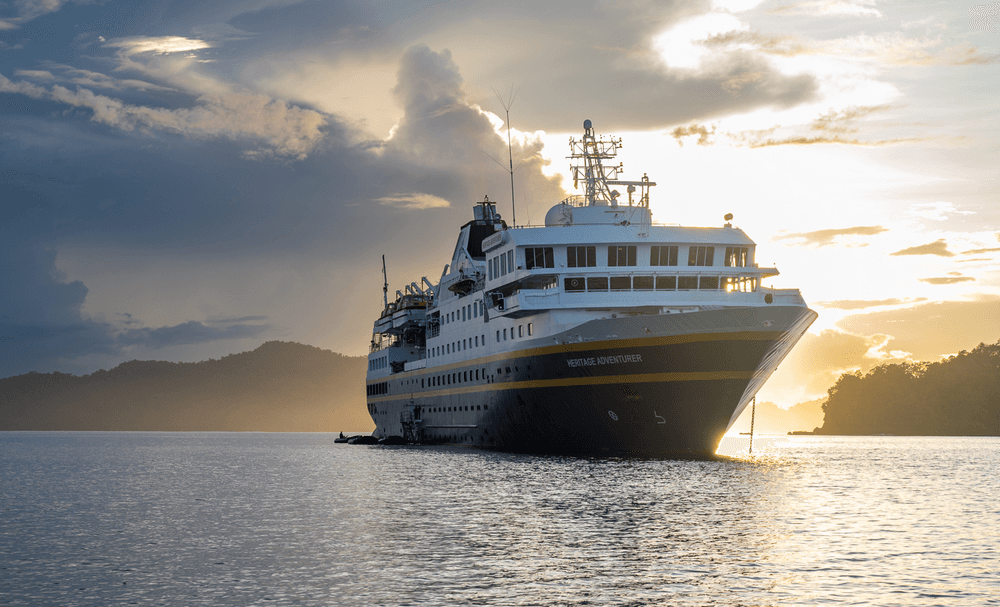
About the Ship
Heritage Adventurer

- 140Guests
- 1991Launched
- 124 mLength
All ship facts
- Decks
- 7
- Gross tonnage
- 8378
- Speed
- 15 kts
- Width
- 18 m
- Language
- de+en