

Forgotten Islands of the South Pacific
All departures of this tripCRUISE ID # HERITAGEHA0271226a
Queenstown TO Queenstown
Suites & Fares
Itinerary
- Day 1December 24, 2027
Pre-Cruise Night
- Day 2December 25, 2027
Pre-Cruise Night
- Day 3December 26, 2027
Invercargill, New Zealand
Guests should make their way to the designated hotel in Invercargill where we will spend the first night of the expedition, or join our 3pm or 6pm Queenstown transfers from a designated meeting point to Invercargill. This evening there will be an informal get-together at the hotel for dinner; an excellent opportunity to meet fellow adventurers on your voyage and some of our expedition team. - Day 3December 26, 2027
Queenstown, New Zealand
- Day 4December 27, 2027
Bluff, New Zealand
The most southernmost town in New Zealand, Bluff (or The Bluff as it is locally known) is perhaps the most European of all the settlements in the country. Called Campbelltown until 1917, the city was officially renamed after the 265 meter conical hill that towers above it. One of the farthest corners of the British Empire, the inaugural Royal Tour of New Zealand by Queen Elizabeth II and Prince Philip, the Duke of Edinburgh, concluded at Bluff in January 1954. Nowadays however, it is the Bluff oysters that are the stars of the show. Reputed to be the best in the world, these local heroes are what have really put Bluff on the map and are celebrated every May with a lively festival honouring Ostrea chilensis (that’s Latin for Bluff oyster). But gastronomy aside (and it is mostly oyster related), Bluff offers the adventurous traveller much in the way activity. Gateway to Stewart Island, day trippers here might enjoy hopping on the ferry for the hour long trip to Stewart Island, or New Zealand’s third island. Unspoilt, tranquil and stunning, Stewart Island is a showcase for New Zealand’s undiscovered tourism spots due to its privileged (yet remote) position in the world. However, for those who wish to stay on the mainland, the Bluff Maritime Museum is a “must visit” for anyone travelling along the Southern Scenic Route, with fascinating historical information about the many early shipwrecks in these challenging southern waters and coastlines. The comprehensive network of walking tracks will delight the ornithologists amongst you – just don’t forget your binoculars!
- Day 5December 28, 2027
Day at Sea
- Day 6December 29, 2027
Campbell Island, New Zealand
The Campbell Islands are a group of subantarctic islands in New Zealand. Known for its rich flora display, Campbell Islands are overflowing with megaherbs, herbaceous, perennial wildflowers which are recognised for their great size, colourful flowers and large leaves. The islands are furthermore home to some rare, and critically endangered birds including the Campbell Island teal and snipe. Enjoy a guided walk on the Col Lyell Saddle boardwalk and head out on the Zodiac for a unique tour around the coastline of Perseverance Harbour.
- Day 7December 30, 2027
Carnley Harbor, Auckland Islands, New Zealand
In the south of the archipelago there is a very large sheltered harbour rich in human history including shipwrecks, treasure hunters, Coastwatchers and, of course, scientific parties. We plan to arrive mid-morning entering the harbour through the eastern entrance which is guarded on both sides by dramatic cliffs and climb there will be an opportunity to Zodiac cruise along the coast of Adams Island, Western Harbour and Victoria Passage. Other options include the Tagua Bay Coastwatcher’s hut and lookout which was occupied during the Second World War. We could visit Epigwatt and the remains of the Grafton which was wrecked here in 1864. All five men aboard survived and lived here for 18 months before sailing their modified dinghy to New Zealand to get help. Two of the survivors wrote books about their ordeal, their first-hand accounts tell us a lot about their time here. Later this evening we will sail up the eastern coast, making our way to Port Ross in preparation for our landing at Enderby Island. - Day 8December 31, 2027
Enderby Island, New Zealand
Enderby Island is the second largest island in the archipelago which is brimming with a magnificent flora and fauna environment. The island has become well known for being home to the rare yellow-eyed penguin and it is further the primary breeding location for the New Zealand Sra Lion. Enjoy a guided tour of the Northern Cliffs track and if you’re lucky, spend some time observing the sea lion colony.
- Day 9January 01, 2028
Snares Islands, New Zealand
The Snares Islands, also known as ‘The Snares’ are the northernmost of New Zealand's subantarctic islands. The islands are totally uninhabited and land mammals were never introduced on the islands, so it is only inhabited by sea mammals, birds and flora. The area is among one of five subantarctic island groups forming the New Zealand Subantarctic Islands, designated as a World Heritage Site by UNESCO.
- Day 10January 02, 2028
Oban, Stewart Island, New Zealand
Stewart Island is home to New Zealand's newest national park, Rakiura National Park. The third and most southerly of New Zealand's main islands, Stewart Island is separated from the South Island by the 24-km (15-miles) Foveaux Strait. Its original Māori name, Te Punga O Te Waka a Maui, means "the anchor stone of Maui's canoe." Māori mythology says the island's landmass held the god Maui's canoe secure while he and his crew raised the great fish—the North Island. Today the island is more commonly referred to by its other Māori name, Rakiura, which means "the land of the glowing skies." This refers to the spectacular sunrises and sunsets and to the southern lights, or aurora australis. The European name of Stewart Island dates back to 1809. It memorializes an officer William W. Stewart on an early sealing vessel, the Pegasus, who was the first to chart the island. The island covers some 1,700 square km (650 square miles). It measures about 75 km (46 miles) from north to south and about the same distance across at its widest point. On the coastline, sharp cliffs rise from a succession of sheltered bays and beaches. In the interior, forested hills rise gradually toward the west side of the island. Seals and penguins frequent the coast, and the island's prolific birdlife includes a number of species rarely seen in any other part of the country. In fact, this is the surest place to see a kiwi. The Stewart Island brown kiwi, or tokoeka, is the largest species of this kind of bird. Unlike their mainland cousins, these kiwis can be seen during the day as well as at night. It's a rare and amusing experience to watch these pear-shape birds scampering on a remote beach as they feed on sand hoppers and grubs. Māori have visited Stewart Island for centuries. Archaeologists' studies of 13th-century Māori middens (refuse heaps) indicate that the island was once a rich, seasonal resource for hunting, fishing, and gathering seafood. A commonly eaten delicacy at that time, the titi, also known as the muttonbird, still occasionally appears on menus. In the early 19th century, explorers, sealers, missionaries, and miners settled the island. They were followed by fishermen and sawmillers who established settlements around the edges of Paterson Inlet and Halfmoon and Horseshoe bays. In the 1920s Norwegians set up a whaling enterprise, and many descendants of these seafaring people remain. Fishing, aquaculture, and tourism are now the mainstays of the island's economy. Even by New Zealand standards, Stewart Island is remote, raw, and untouched. The appeal is its seclusion, its relaxed way of life, and its untouched quality. Stewart Island is not for everyone: if you must have shopping malls, casinos, or umbrella drinks on the beach, don't come here. Visitors should be prepared for the fact that Stewart Island can be chilly, windy, and rainy, even in the middle of summer.
- Day 10January 02, 2028
Invercargill, New Zealand
- Day 10January 02, 2028
Queenstown, New Zealand
About the Ship
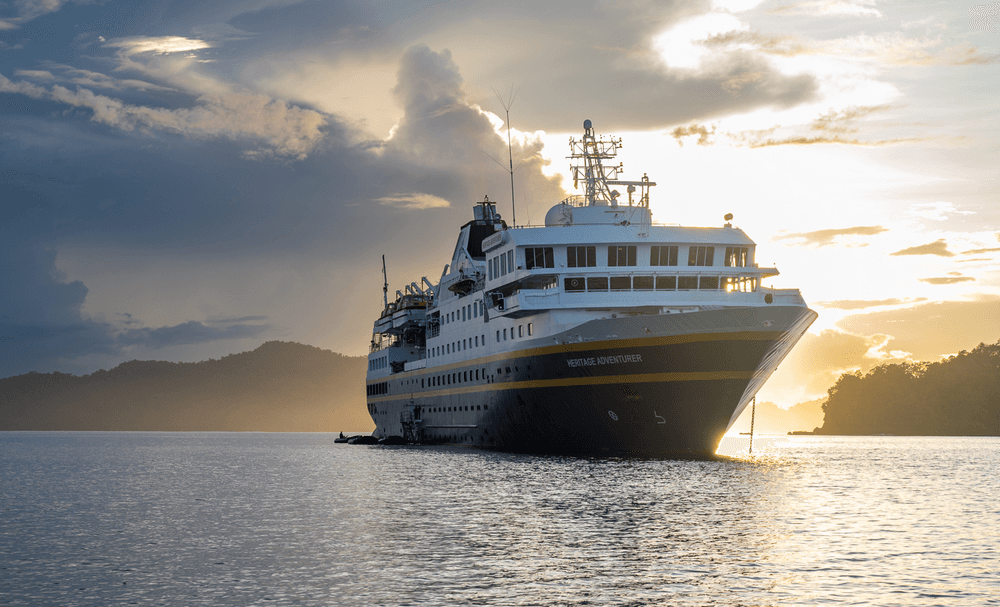
Heritage Adventurer

- 140Guests
- 1991Launched
- 124 mLength
All ship facts
- Decks
- 7
- Gross tonnage
- 8378
- Speed
- 15 kts
- Width
- 18 m
- Language
- de+en