

CRUISE ID # HERITAGEHA271201
Queenstown TO Queenstown
Suites & Fares
Itinerary
- Day 1November 30, 2027
Pre-Cruise Night
- Day 2December 01, 2027
Queenstown, New Zealand
Guests should make their way to the designated hotel where we will spend the first night of the expedition. This evening there will be an informal get-together at the hotel for dinner; an excellent opportunity to meet fellow adventurers on your voyage and some of our expedition team. - Day 3December 02, 2027
Bluff, New Zealand
The most southernmost town in New Zealand, Bluff (or The Bluff as it is locally known) is perhaps the most European of all the settlements in the country. Called Campbelltown until 1917, the city was officially renamed after the 265 meter conical hill that towers above it. One of the farthest corners of the British Empire, the inaugural Royal Tour of New Zealand by Queen Elizabeth II and Prince Philip, the Duke of Edinburgh, concluded at Bluff in January 1954. Nowadays however, it is the Bluff oysters that are the stars of the show. Reputed to be the best in the world, these local heroes are what have really put Bluff on the map and are celebrated every May with a lively festival honouring Ostrea chilensis (that’s Latin for Bluff oyster). But gastronomy aside (and it is mostly oyster related), Bluff offers the adventurous traveller much in the way activity. Gateway to Stewart Island, day trippers here might enjoy hopping on the ferry for the hour long trip to Stewart Island, or New Zealand’s third island. Unspoilt, tranquil and stunning, Stewart Island is a showcase for New Zealand’s undiscovered tourism spots due to its privileged (yet remote) position in the world. However, for those who wish to stay on the mainland, the Bluff Maritime Museum is a “must visit” for anyone travelling along the Southern Scenic Route, with fascinating historical information about the many early shipwrecks in these challenging southern waters and coastlines. The comprehensive network of walking tracks will delight the ornithologists amongst you – just don’t forget your binoculars!
- Day 4December 03, 2027
Snares Islands, New Zealand
The Snares Islands, also known as ‘The Snares’ are the northernmost of New Zealand's subantarctic islands. The islands are totally uninhabited and land mammals were never introduced on the islands, so it is only inhabited by sea mammals, birds and flora. The area is among one of five subantarctic island groups forming the New Zealand Subantarctic Islands, designated as a World Heritage Site by UNESCO.
- Day 5December 04, 2027
Enderby Island, New Zealand
Enderby Island is the second largest island in the archipelago which is brimming with a magnificent flora and fauna environment. The island has become well known for being home to the rare yellow-eyed penguin and it is further the primary breeding location for the New Zealand Sra Lion. Enjoy a guided tour of the Northern Cliffs track and if you’re lucky, spend some time observing the sea lion colony.
- Day 6December 05, 2027
Day at Sea
- Day 7December 06, 2027
Macquarie Island, Tasmania, Australia
Macquarie Island is a UNESCO World Heritage Site due to its major geoconservation significance. It is the only island in the world that is entirely composed of oceanic crust and rocks from the mantel. The unique diversity of the island makes it a truly remarkable place to visit. Sand Bay is located on the east coast where you will find Royal and King Penguin rookeries as well as Southern Elephant Seals, and if the weather permits, you will have the opportunity to get closer on a Zodiac®.
- Day 8December 07, 2027
Macquarie Island, Tasmania, Australia
Macquarie Island is a UNESCO World Heritage Site due to its major geoconservation significance. It is the only island in the world that is entirely composed of oceanic crust and rocks from the mantel. The unique diversity of the island makes it a truly remarkable place to visit. Sand Bay is located on the east coast where you will find Royal and King Penguin rookeries as well as Southern Elephant Seals, and if the weather permits, you will have the opportunity to get closer on a Zodiac®.
- Day 9December 08, 2027
Day at Sea
- Day 10December 09, 2027
Perseverance Harbour, Campbell Island, New Zealand
Today we explore Campbell Island, New Zealand’s southernmost Subantarctic territory. Its history is as rich and varied as the other islands we visit. Discovered in 1810, it was soon occupied by sealers who introduced rats and cats. Farming followed from 1895 to 1934 when it was abandoned. Coastwatchers were stationed on the island during the war and at the end of the war the station was taken over by the New Zealand Metrological service. They maintained a manned weather/ research station there until 1995. In the early 1970s the removal of farm animals commenced and all were eventually removed by 1990. The vegetation recovered quickly and the cats died out naturally. In a very ambitious (and never before attempted on such a large scale) eradication programme the New Zealand Department of Conservation successfully removed the rats. With the island declared predator free, the way was clear to reintroduce the endangered Campbell Island Flightless Teal, which had been rediscovered on an offshore island in 1975. Snipe, which were formerly unknown from the island but were discovered on another offshore island, recolonised the islands themselves. The vegetation which the great English botanist Sir Joseph Hooker described in 1841 as having a “Flora display second to none outside the tropics” is flourishing and is nothing short of spectacular. We will offer a number of options which will enable you to explore the island including an extended walk to Northwest Bay. There will also be an easier walk to the Col Lyall Saddle. All of these options will allow you the opportunity and time to enjoy the Southern Royal Albatross which nest here in large numbers. We also visit areas of the island which contain outstanding examples of the megaherbs for which the island is renowned. - Day 11December 10, 2027
Day at Sea
- Day 12December 11, 2027
Antipodes Islands, New Zealand
The Antipodes group of islands is the most isolated and perhaps the least known of New Zealand’s Subantarctic Islands. Sealers lived here in the decades immediately after their discovery in 1806. The islands are of volcanic origin, but are heavily eroded especially the western shoreline. The largest of the group is Antipodes Island. Landings are not permitted so we plan to cruise, along the coastline by Zodiac where we have a good chance of seeing the Antipodes Parakeet, the largest of New Zealand’s parakeets. This species has an entirely green head. We will also look for the Reischek’s Parakeet, a subspecies of the Red-crowned Parakeet found in the Auckland Islands and on the Chatham Islands. We also see the Antipodes subspecies of the New Zealand Pipit. Good views of both Erect-crested and Rockhopper Penguins can be expected along the coast where they often breed in mixed colonies. - Day 13December 12, 2027
Bounty Islands, New Zealand
We arrive at the incongruously named Bounty Islands, the remote northernmost of the five New Zealand Subantarctic groups; they were discovered by Captain Bligh just months before the infamous mutiny. Here inhospitable granite knobs, tips of the submerged Bounty Platform, are lashed by the Southern Ocean. They are home to thousands of Salvin’s Albatross, Erect-crested Penguins, Fulmar Prions and the endemic Bounty Island Shag – the world’s rarest. We plan to arrive in the early morning and if conditions are suitable we will cruise by Zodiac around the granite outposts to take a closer look at the birds which breed there. New Zealand Fur Seals which were almost hunted to extinction in the Subantarctic Islands are present in large numbers. Sailing towards the Chatham Islands there are opportunities to see a good selection of birdlife as we sail. These should include Wandering Albatross, Northern Royal Albatross, Mottled Petrel, Soft-plumaged Petrel, Broad-billed Prion, White-chinned Petrel and Black-bellied Storm-Petrel as well as Wilson’s Storm-Petrel. Other possible sightings include White-capped Albatross, Northern Giant Petrel, Cape Petrel, Antarctic Fulmar, Sooty Shearwater, Little Shearwater and Grey-backed Storm-petrel. We will also start to keep a lookout for the Chatham Island Petrel. - Day 14December 13, 2027
Chatham Islands, New Zealand
As we continue toward the Chatham Archipelago, there are excellent opportunities for pelagic birding today. In particular, we will look out for the Chatham Island Petrel which has been seen on this leg of the voyage before. In the past we have observed the very rare Chatham Island Taiko in this area. Endemic to the Chatham Islands, the Chatham Island Taiko – also known as the Magenta Petrel – is among New Zealand’s most endangered species. It is one of the world’s rarest seabirds with a population estimated to number less than 150. This afternoon we will cruise around spectacular Pyramid Rock, a basalt outcrop south of Pitt Island. This is the only breeding place of the Chatham Island Albatross. During the afternoon we arrive at South East Island. This has to be one of the world’s greatest nature reserves and landings are not permitted. However we should obtain good views of the very rare New Zealand Shore Plover and Chatham Island Oystercatcher from the Zodiacs as we cruise along the coast. We should also see the Pitt Island Shag which nests on the island. - Day 15December 14, 2027
Waitangi, Bay of Islands, New Zealand
The Chatham Archipelago consists of one large island and numerous smaller islands and rocky islets. Only two of the islands are inhabited. They represent New Zealand’s eastern most territory. The islands were originally settled by East Polynesians. In the 1400s the population became isolated and interestingly developed its own distinct culture. The islands were discovered by Europeans in the 1790s. Sealers and settlers followed and then in the 1830s Māori from New Zealand invaded killing and enslaving many of the indigenous people. The impact of the original settlers, the Europeans and later the Maori people on the native flora and fauna was disastrous. Introduced animals, hunting, fires and land clearing wiped out many species of endemic birds. Fortunately a number survived on the offshore islands in the archipelago. With a new generation has come a new awareness and a willingness to be part of a concerted conservation effort. A number of private reserves have been established, a lot of replanting has taken place and predators are being controlled. Today we will visit one of the original private reserves established by a local family on the south coast of the main island where there is a very good chance to see the endemic Chatham Island Pigeon and Warbler. The pigeon was close to extinction until recently, and is now in good numbers. We will travel by local bus to the reserve. The road takes us through developed farmland where we will undoubtedly see numerous introduced species and possibly the Weka. Near our landing in Waitangi there is a good chance of seeing the endemic Chatham Island Shag. This afternoon we cruise back along the south coast, this is where the only known population of the Taiko breeds and also where they are attempting to establish a new population of the Chatham Island Petrel in a predator free area. We have seen both Taiko and Chatham Island Petrel in this area on previous expeditions. - Day 16December 15, 2027
Day at Sea
- Day 17December 16, 2027
Day at Sea
- Day 18December 17, 2027
Invercargill, New Zealand
Early this morning we will arrive in the Port of Bluff. After a final breakfast we bid farewell to our fellow voyagers and take a complimentary coach transfer to either Invercargill or Queenstown Airports. In case of unexpected delays due to weather and/or port operations we ask you not to book any onward travel until after midday from Invercargill and after 3pm from Queenstown. Note: During our voyage, circumstances may make it necessary or desirable to deviate from the proposed itinerary. This can include poor weather and opportunities for making unplanned excursions. Your Expedition Leader will keep you fully informed. Landings at the Subantarctic Islands of New Zealand are by permit only as administered by the Government of New Zealand. No landings are permitted at The Snares, Antipodes or Bounties. - Day 18December 17, 2027
Queenstown, New Zealand
About the Ship
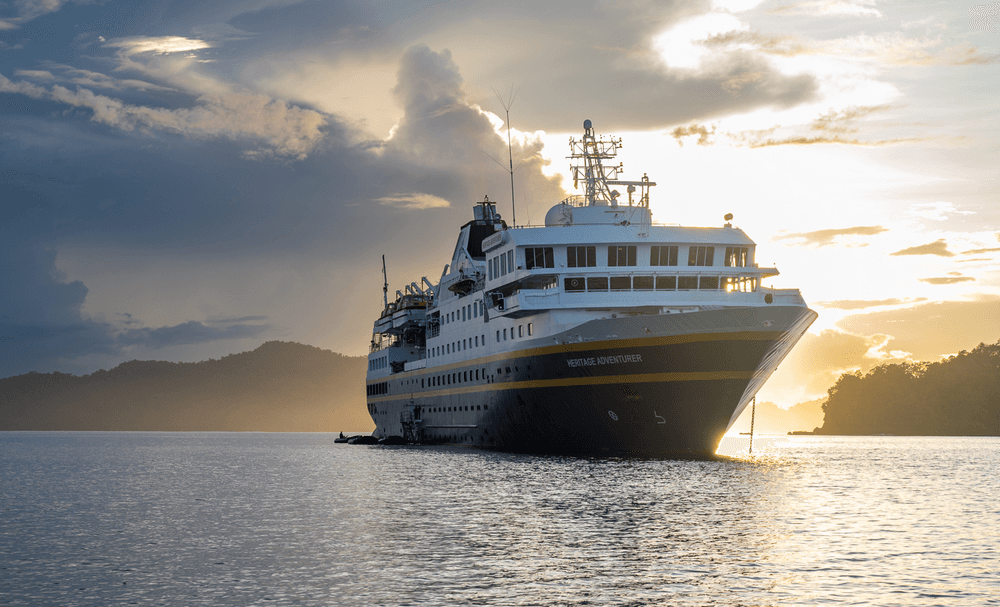
Heritage Adventurer

- 140Guests
- 1991Launched
- 124 mLength
All ship facts
- Decks
- 7
- Gross tonnage
- 8378
- Speed
- 15 kts
- Width
- 18 m
- Language
- de+en