

CRUISE ID # ADVCANADAA227-OV
Kugluktuk, Nunavut TO Kangerlussuaq Havn
Suites & Fares
Itinerary
- Day 1September 10, 2027
Kugluktuk, Nunavut, Canada
Your journey begins at Kugluktuk—the westernmost community in Nunavut—where the Coppermine River meets the open sea. Its Inuinnaqtun name means “place of moving waters,” a fitting departure for a voyage defined by flow and connection. Explore this welcoming community known for artistry and warmth. Local hosts share stories of life in the western Arctic, where tradition and modern life move together with the rhythm of tide and season. As you embark on your ice-class expedition vessel, the horizon opens before you—an expanse of muted blues and greys threaded with drifting ice. The ship turns east, tracing the first lines of the storied Northwest Passage. - Day 2September 11, 2027
Exploring the Kitikmeot Region, Nunavut
The Kitikmeot Region stretches across the central Arctic, a landscape of tundra, island chains, and shifting sea ice. This is the heart of the Northwest Passage—a place where the stories of Inuit and explorers intertwine across centuries. Visit a community where you are welcomed as a guest. Hear from Inuit hosts about local history, hunting traditions, and daily life. The scent of tundra moss, the laughter of children, and the steady thrum of a drum dance create a portrait of life deeply rooted in place. Zodiac excursions explore quiet bays where caribou and muskoxen graze beneath wide skies. - Day 3September 12, 2027
Exploring the Kitikmeot Region, Nunavut
The Kitikmeot Region stretches across the central Arctic, a landscape of tundra, island chains, and shifting sea ice. This is the heart of the Northwest Passage—a place where the stories of Inuit and explorers intertwine across centuries. Visit a community where you are welcomed as a guest. Hear from Inuit hosts about local history, hunting traditions, and daily life. The scent of tundra moss, the laughter of children, and the steady thrum of a drum dance create a portrait of life deeply rooted in place. Zodiac excursions explore quiet bays where caribou and muskoxen graze beneath wide skies. - Day 4September 13, 2027
Exploring the Kitikmeot Region, Nunavut
The Kitikmeot Region stretches across the central Arctic, a landscape of tundra, island chains, and shifting sea ice. This is the heart of the Northwest Passage—a place where the stories of Inuit and explorers intertwine across centuries. Visit a community where you are welcomed as a guest. Hear from Inuit hosts about local history, hunting traditions, and daily life. The scent of tundra moss, the laughter of children, and the steady thrum of a drum dance create a portrait of life deeply rooted in place. Zodiac excursions explore quiet bays where caribou and muskoxen graze beneath wide skies. - Day 5September 14, 2027
Bellot Strait, Nunavut, Canada
Reach Ikirahaq—known to many as Bellot Strait—a narrow channel where the tides of east and west converge. Threading between Somerset Island and the Boothia Peninsula, it marks the northernmost tip of continental North America. Granite headlands rise close on either side, streaked with scree, snow, and time. The currents twist and surge beneath the hull, where seals, seabirds, and occasional belugas or narwhals forage for food. For Inuit, Ikirahaq has long been a place of movement and gathering—a reminder that the meeting of waters mirrors the meeting of stories. - Day 6September 15, 2027
Beechey Island, Nunavut, Canada
Beechey Island is a small island off the southwest coast of Devon Island, separated by a narrow waterway called the Barrow Strait. Captain William Edward Parry was the first European to visit the island in 1819. His lieutenant, Frederick William Beechey, named the island after his father, the artist William Beechey (1753–1839). Beechey Island played a significant role in the history of Arctic Exploration. During the winter of 1845-46, Sir John Franklin and his men camped on the island as part of their ill-fated quest to find the Northwest Passage. Mummified remains of three of Franklin’s crew were discovered, giving a better understanding of what happened before the disappearance of the expedition. In 1850 Edward Belcher used the island as a base while surveying the area. Later, in 1903, Norwegian explorer Roald Amundsen stopped at the island at the beginning of his successful voyage in search for the Northwest Passage. Subsequently, Beechey Island has been declared a "Territorial Historic Site" since 1975 by the Northwest Territories government
- Day 7September 16, 2027
Lancaster Sound, Tallurutiup Imanga National Park, Nunavut, Canada
Enter Tallurutiup Imanga, a great inlet where glaciers feed cold, life-rich waters. Designated as one of Canada’s largest National Marine Conservation Areas, it is a confluence of nature and culture. Inuit knowledge and stewardship sustain a balance as intricate as the migration of narwhal and bowhead. Watch for polar bears on the ice, walrus on floes, and seabirds circling overhead. Devon Island rises to the north, vast and uninhabited—a landscape of stone and silence. Hike across tundra valleys where traces of ancient camps speak to the endurance of those who have travelled this coast for generations. - Day 8September 17, 2027
Lancaster Sound, Tallurutiup Imanga National Park, Nunavut, Canada
Enter Tallurutiup Imanga, a great inlet where glaciers feed cold, life-rich waters. Designated as one of Canada’s largest National Marine Conservation Areas, it is a confluence of nature and culture. Inuit knowledge and stewardship sustain a balance as intricate as the migration of narwhal and bowhead. Watch for polar bears on the ice, walrus on floes, and seabirds circling overhead. Devon Island rises to the north, vast and uninhabited—a landscape of stone and silence. Hike across tundra valleys where traces of ancient camps speak to the endurance of those who have travelled this coast for generations. - Day 9September 18, 2027
Grise Fjord, Canada
Grise Fiord is an Inuit hamlet on the southern tip of Ellesmere Island, in the Qikiqtaaluk Region, Nunavut, Canada. It is one of three populated places on the island; despite its low population, it is the largest community on Ellesmere Island.
- Day 10September 19, 2027
Cruising Smith Sound
Sail into Smith Sound, a broad waterway marking the meeting place of Canada and Greenland—and, historically, the threshold to the North Pole. Icebergs drift south from Greenland’s glaciers, glowing with every hue of blue. For centuries, Inuit hunters have crossed its frozen expanse, while European expeditions sought passage north through its icy corridors. Today, its silence is punctuated only by wind and the slow fracture of ice. As we continue eastward, the sense of scale deepens—water and sky expanding endlessly, carrying us forward through time and tide. - Day 11September 20, 2027
Day at Sea
- Day 12September 21, 2027
Exploring Northwest Greenland
Crossing into Greenland, the coast reveals a world sculpted by ice. Glaciers descend from the inland cap, feeding fjords that stretch deep into the land. Scattered villages dot the shoreline, their bright homes vivid against the vastness of rock and snow. Go ashore where conditions allow to explore bays fringed with bergs or hike along tundra scented with Arctic cotton and crowberry. Ice and light combine to create a palette of silvers and aquas. Each moment shows how landscape shapes life—and how people, in turn, shape their bond with it. - Day 13September 22, 2027
Exploring Northwest Greenland
Crossing into Greenland, the coast reveals a world sculpted by ice. Glaciers descend from the inland cap, feeding fjords that stretch deep into the land. Scattered villages dot the shoreline, their bright homes vivid against the vastness of rock and snow. Go ashore where conditions allow to explore bays fringed with bergs or hike along tundra scented with Arctic cotton and crowberry. Ice and light combine to create a palette of silvers and aquas. Each moment shows how landscape shapes life—and how people, in turn, shape their bond with it. - Day 14September 23, 2027
Ilulissat (Jakobshavn), Greenland
Known as the birthplace of icebergs, the Ilulissat Icefjord produces nearly 20 million tons of ice each day. In fact, the word Ilulissat means “icebergs” in the Kalaallisut language. The town of Ilulissat is known for its long periods of calm and settled weather, but the climate tends to be cold due to its proximity to the fjord. Approximately 4,500 people live in Ilulissat, the third-largest town in Greenland after Nuuk and Sisimiut. Some people here estimate that there are nearly as many sled dogs as human beings living in the town that also boasts a local history museum located in the former home of Greenlandic folk hero and famed polar explorer Knud Rasmussen.
- Day 15September 24, 2027
Sisimiut (Holsteinsborg), Greenland
Located just north of the Arctic Circle, Sisimiut is the northernmost town in Greenland where the port remains free of ice in the winter. Yet it is also the southernmost town where there is enough snow and ice to drive a dogsled in winter and spring. In Sisimiut, travelling by sled has been the primary means of winter transportation for centuries. In fact, the area has been inhabited for approximately 4,500 years. Modern Sisimiut is the largest business center in the north of Greenland, and is one of the fastest growing Greenlandic cities. Commercial fishing is the lead economy in the town‘s thriving industrial base.
- Day 16September 25, 2027
Sisimiut (Holsteinsborg), Greenland
Located just north of the Arctic Circle, Sisimiut is the northernmost town in Greenland where the port remains free of ice in the winter. Yet it is also the southernmost town where there is enough snow and ice to drive a dogsled in winter and spring. In Sisimiut, travelling by sled has been the primary means of winter transportation for centuries. In fact, the area has been inhabited for approximately 4,500 years. Modern Sisimiut is the largest business center in the north of Greenland, and is one of the fastest growing Greenlandic cities. Commercial fishing is the lead economy in the town‘s thriving industrial base.
- Day 17September 26, 2027
Kangerlussuaq Havn, Greenland
The name Kangerlussuaq means "Big Fjord" in the local Kalaallisut language. The settlement of about 500 people is located in western Greenland on flat land at the head of a fjord with the same name. Kangerlussuaq is the site of Greenland's largest commercial airport and most of the economy here is dependent on the air transportation hub and tourism. The rugged lands around the settlement support terrestrial Arctic fauna including muskoxen, caribou, and Gyrfalcons.
About the Ship
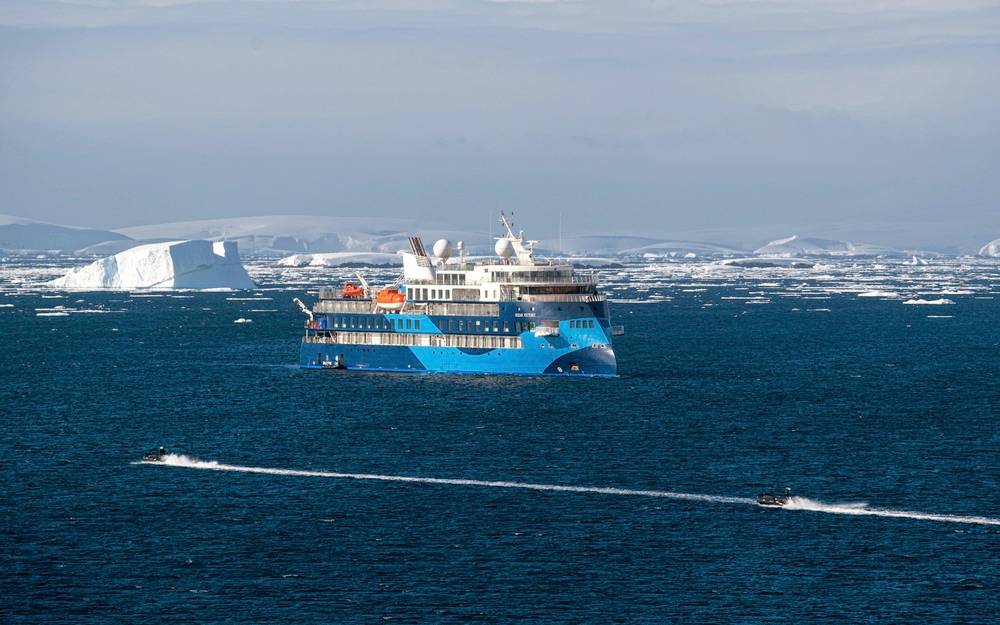
Ocean Victory

- 175Guests
- 93Cabins
- 2021Launched
- 104 mLength
All ship facts
- Crew
- 101
- Decks
- 7
- Gross tonnage
- 8181
- Speed
- 16 kts
- Width
- 18 m
- Currency on board
- USD
- Language
- en-US