

CRUISE ID # ADVCANADAA127-OV
Kangerlussuaq Havn TO Kugluktuk, Nunavut
Suites & Fares
Itinerary
- Day 1August 25, 2027
Kangerlussuaq Havn, Greenland
The name Kangerlussuaq means "Big Fjord" in the local Kalaallisut language. The settlement of about 500 people is located in western Greenland on flat land at the head of a fjord with the same name. Kangerlussuaq is the site of Greenland's largest commercial airport and most of the economy here is dependent on the air transportation hub and tourism. The rugged lands around the settlement support terrestrial Arctic fauna including muskoxen, caribou, and Gyrfalcons.
- Day 2August 26, 2027
Sisimiut (Holsteinsborg), Greenland
Located just north of the Arctic Circle, Sisimiut is the northernmost town in Greenland where the port remains free of ice in the winter. Yet it is also the southernmost town where there is enough snow and ice to drive a dogsled in winter and spring. In Sisimiut, travelling by sled has been the primary means of winter transportation for centuries. In fact, the area has been inhabited for approximately 4,500 years. Modern Sisimiut is the largest business center in the north of Greenland, and is one of the fastest growing Greenlandic cities. Commercial fishing is the lead economy in the town‘s thriving industrial base.
- Day 3August 27, 2027
Sisimiut (Holsteinsborg), Greenland
Located just north of the Arctic Circle, Sisimiut is the northernmost town in Greenland where the port remains free of ice in the winter. Yet it is also the southernmost town where there is enough snow and ice to drive a dogsled in winter and spring. In Sisimiut, travelling by sled has been the primary means of winter transportation for centuries. In fact, the area has been inhabited for approximately 4,500 years. Modern Sisimiut is the largest business center in the north of Greenland, and is one of the fastest growing Greenlandic cities. Commercial fishing is the lead economy in the town‘s thriving industrial base.
- Day 4August 28, 2027
Ilulissat (Jakobshavn), Greenland
Known as the birthplace of icebergs, the Ilulissat Icefjord produces nearly 20 million tons of ice each day. In fact, the word Ilulissat means “icebergs” in the Kalaallisut language. The town of Ilulissat is known for its long periods of calm and settled weather, but the climate tends to be cold due to its proximity to the fjord. Approximately 4,500 people live in Ilulissat, the third-largest town in Greenland after Nuuk and Sisimiut. Some people here estimate that there are nearly as many sled dogs as human beings living in the town that also boasts a local history museum located in the former home of Greenlandic folk hero and famed polar explorer Knud Rasmussen.
- Day 5August 29, 2027
Exploring West Greenland
Along Greenland’s western coast, fjords open like mirrors between mountain and cloud. The tundra rises in gentle folds—moss, stone, and the bright trace of late-summer flowers. From the ship or by Zodiac, we explore sheltered bays and narrow inlets, watching as weather and light shape the day. Where conditions allow, we step ashore to walk the tundra, guided by Inuit expedition team members who share stories of the plants, animals, and ancestral presence that knit this landscape together. Every encounter—whether with the quiet rhythm of waves on rock or the sudden lift of a seabird—becomes a lesson in attention. As we sail westward, Greenland falls behind and Baffin Bay opens ahead. The sea stretches to the horizon, vast and still, carrying us toward the Canadian Arctic and the next chapter of the passage. - Day 6August 30, 2027
Cruising Davis Strait
Between Greenland and Baffin Island lies Davis Strait, a vast expanse where ocean and ice mingle in a dance of shifting light. The ship glides through open water, the horizon moving gently with each breath of wind. This is a day for pleasure as much as discovery—for letting the rhythm of the sea relax the mind, for feeling joy in the quiet act of watching and listening. Here, learning unfolds not as effort, but as delight. From the decks, scan for minke and humpback whales, their sleek backs cutting the surface before vanishing again. Fulmars and kittiwakes wheel above the ship, while murres and dovekies gather on the water in small, dark rafts, rising and dipping with the swell. Inside, join workshops and presentations that deepen understanding of the Arctic’s ecology, culture, and story. Here, in the heart of Inuit Nunangat, learn directly from Inuit educators and cultural ambassadors. Through shared games, food, and conversation, they offer insight into daily life and the enduring relationship between people and place. Knowledge, like the sea itself, flows in every direction—connecting past and present, traveller and host. - Day 7August 31, 2027
Devon Island, Nunavut, Canada
Devon Island, located in Baffin Bay, is only slightly smaller than Croatia. The eastern side is frosted by the Devon Ice Cap, while on the western half of the island lays the 14 mile wide Haughton impact crater. It was created around 39 million years ago when a meteorite crashed into the land. The landscape surrounding this site resembles the surface of Mars. In fact, for the past decade scientists have conducted research here to determine how humans might live one day on Mars. British Arctic explorers Robert Bylot and William Baffin were the first Europeans to sight the island in 1616. In 1819-1820, William Parry charted the island, naming it North Devon after Devon in England. Despite repeated attempts at trading settlements, the strong wind conditions and cold climate eventually drove everyone away leaving Devon Island as a likely candidate for being the world’s largest uninhabited island.
- Day 8September 01, 2027
Devon Island, Nunavut, Canada
Devon Island, located in Baffin Bay, is only slightly smaller than Croatia. The eastern side is frosted by the Devon Ice Cap, while on the western half of the island lays the 14 mile wide Haughton impact crater. It was created around 39 million years ago when a meteorite crashed into the land. The landscape surrounding this site resembles the surface of Mars. In fact, for the past decade scientists have conducted research here to determine how humans might live one day on Mars. British Arctic explorers Robert Bylot and William Baffin were the first Europeans to sight the island in 1616. In 1819-1820, William Parry charted the island, naming it North Devon after Devon in England. Despite repeated attempts at trading settlements, the strong wind conditions and cold climate eventually drove everyone away leaving Devon Island as a likely candidate for being the world’s largest uninhabited island.
- Day 9September 02, 2027
Devon Island, Nunavut, Canada
Devon Island, located in Baffin Bay, is only slightly smaller than Croatia. The eastern side is frosted by the Devon Ice Cap, while on the western half of the island lays the 14 mile wide Haughton impact crater. It was created around 39 million years ago when a meteorite crashed into the land. The landscape surrounding this site resembles the surface of Mars. In fact, for the past decade scientists have conducted research here to determine how humans might live one day on Mars. British Arctic explorers Robert Bylot and William Baffin were the first Europeans to sight the island in 1616. In 1819-1820, William Parry charted the island, naming it North Devon after Devon in England. Despite repeated attempts at trading settlements, the strong wind conditions and cold climate eventually drove everyone away leaving Devon Island as a likely candidate for being the world’s largest uninhabited island.
- Day 10September 03, 2027
Beechey Island, Nunavut, Canada
Beechey Island is a small island off the southwest coast of Devon Island, separated by a narrow waterway called the Barrow Strait. Captain William Edward Parry was the first European to visit the island in 1819. His lieutenant, Frederick William Beechey, named the island after his father, the artist William Beechey (1753–1839). Beechey Island played a significant role in the history of Arctic Exploration. During the winter of 1845-46, Sir John Franklin and his men camped on the island as part of their ill-fated quest to find the Northwest Passage. Mummified remains of three of Franklin’s crew were discovered, giving a better understanding of what happened before the disappearance of the expedition. In 1850 Edward Belcher used the island as a base while surveying the area. Later, in 1903, Norwegian explorer Roald Amundsen stopped at the island at the beginning of his successful voyage in search for the Northwest Passage. Subsequently, Beechey Island has been declared a "Territorial Historic Site" since 1975 by the Northwest Territories government
- Day 11September 04, 2027
Bellot Strait, Nunavut, Canada
We reach Ikirahaq, known to many as Bellot Strait—a narrow, two-kilometre channel where the currents of the western and eastern Arctic converge. Threading between Somerset Island and the Boothia Peninsula, it marks the northernmost point of continental North America. The currents here are swift and precise, changing direction with the breathing of the tides. From the deck, granite walls rise close on either side, streaked with snow and shadow. Beluga whales, narwhals, and seals might surface in the swirling water; seabirds flock to feed on the small creatures swept through by the currents. For Inuit, Ikirahaq has long been a place of passage and gathering, known for its moving ice and the life that travels with it. In the 1850s, Joseph René Bellot, a French naval officer, joined the search for Franklin and lent his name to the strait—though its story runs far deeper than any map. To pass through Ikirahaq is to feel that meeting of worlds: east and west, land and sea, past and present. The water quickens beneath the hull, and the voyage turns once more toward the heart of the Passage. - Day 12September 05, 2027
Exploring the Kitikmeot Region, Nunavut
We sail west into the Kitikmeot Region, the heart of the Northwest Passage. Sea ice drifts in quiet mosaics; the coastline unfolds in muted browns and silver blues. Though sparsely populated, these lands and waters hold life—muskoxen and caribou on the tundra, seals and whales in the shifting sea. This is the setting of many historic journeys. Roald Amundsen overwintered nearby for two years while completing the first full transit of the Passage. His success rested on knowledge learned from Inuit—skills of survival and navigation born of generations living with ice and weather. Each day brings new light and new waters. We move steadily westward, carried by the rhythm of the sea and the enduring presence of those who know it best. - Day 13September 06, 2027
Exploring the Kitikmeot Region, Nunavut
We sail west into the Kitikmeot Region, the heart of the Northwest Passage. Sea ice drifts in quiet mosaics; the coastline unfolds in muted browns and silver blues. Though sparsely populated, these lands and waters hold life—muskoxen and caribou on the tundra, seals and whales in the shifting sea. This is the setting of many historic journeys. Roald Amundsen overwintered nearby for two years while completing the first full transit of the Passage. His success rested on knowledge learned from Inuit—skills of survival and navigation born of generations living with ice and weather. Each day brings new light and new waters. We move steadily westward, carried by the rhythm of the sea and the enduring presence of those who know it best. - Day 14September 07, 2027
Exploring the Kitikmeot Region, Nunavut
We sail west into the Kitikmeot Region, the heart of the Northwest Passage. Sea ice drifts in quiet mosaics; the coastline unfolds in muted browns and silver blues. Though sparsely populated, these lands and waters hold life—muskoxen and caribou on the tundra, seals and whales in the shifting sea. This is the setting of many historic journeys. Roald Amundsen overwintered nearby for two years while completing the first full transit of the Passage. His success rested on knowledge learned from Inuit—skills of survival and navigation born of generations living with ice and weather. Each day brings new light and new waters. We move steadily westward, carried by the rhythm of the sea and the enduring presence of those who know it best. - Day 15September 08, 2027
Exploring the Kitikmeot Region, Nunavut
We sail west into the Kitikmeot Region, the heart of the Northwest Passage. Sea ice drifts in quiet mosaics; the coastline unfolds in muted browns and silver blues. Though sparsely populated, these lands and waters hold life—muskoxen and caribou on the tundra, seals and whales in the shifting sea. This is the setting of many historic journeys. Roald Amundsen overwintered nearby for two years while completing the first full transit of the Passage. His success rested on knowledge learned from Inuit—skills of survival and navigation born of generations living with ice and weather. Each day brings new light and new waters. We move steadily westward, carried by the rhythm of the sea and the enduring presence of those who know it best. - Day 16September 09, 2027
Cambridge Bay, Nunavut, Canada
We arrive at Iqaluktuuttiaq, or Cambridge Bay, a welcoming community on the southern coast of Victoria Island. Its name—“place of many fish”—speaks to the abundance that has long sustained life here. Join a guided tour to learn about daily life in the Kitikmeot Region, where tradition and innovation meet. Visit the Canadian High Arctic Research Station (CHARS), a state-of-the-art facility operated by Polar Knowledge Canada, dedicated to studying Arctic ecosystems and climate through collaboration between science and Indigenous knowledge. Explore local arts and crafts—carvings, prints, beadwork—each carrying stories of skill, connection, and endurance. As evening light settles over the tundra, the sea glows with the last warmth of summer, and the voyage begins to turn toward home. - Day 17September 10, 2027
Kugluktuk, Nunavut, Canada
Our voyage ends at Kugluktuk, the westernmost community in Nunavut, where the Coppermine River meets the sea. Its Inuinnaqtun name means “place of moving waters,” a fitting farewell after weeks spent following the rhythms of ice and tide. Step ashore to explore this warm and welcoming community, known for its artistry and deep connection to the surrounding land. Here, stories flow as steadily as the river itself—threads of history, language, and belonging carried forward through generations. Depending on sea, ice, and weather conditions, Iqaluktuuttiaq (Cambridge Bay) may serve as an alternate disembarkation point. From either location, guests will board a charter flight to Yellowknife, Northwest Territories, marking the final leg of the journey south. In the soft northern light, we say goodbye to shipmates and newfound friends, carrying with us the quiet understanding that the Arctic does not end—it continues to move, to teach, and to remind.
About the Ship
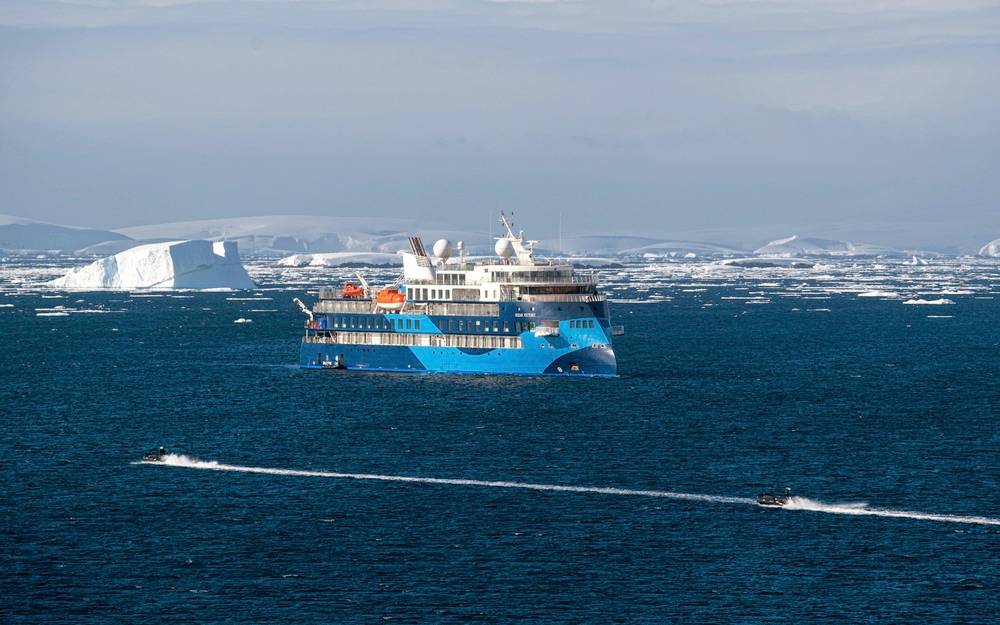
Ocean Victory

- 175Guests
- 93Cabins
- 2021Launched
- 104 mLength
All ship facts
- Crew
- 101
- Decks
- 7
- Gross tonnage
- 8181
- Speed
- 16 kts
- Width
- 18 m
- Currency on board
- USD
- Language
- en-US