

Greenland & Wild Labrador: A Torngat Mountains Adventure
All departures of this tripCRUISE ID # ADVCANADAGL28-ON
Kangerlussuaq Havn TO Saint-John's, Newfoundland and Labrador
Suites & Fares
Itinerary
- Day 1September 16, 2028
Kangerlussuaq Havn, Greenland
The name Kangerlussuaq means "Big Fjord" in the local Kalaallisut language. The settlement of about 500 people is located in western Greenland on flat land at the head of a fjord with the same name. Kangerlussuaq is the site of Greenland's largest commercial airport and most of the economy here is dependent on the air transportation hub and tourism. The rugged lands around the settlement support terrestrial Arctic fauna including muskoxen, caribou, and Gyrfalcons.
- Day 2September 17, 2028
Evighedsfjorden, Greenland
Kangerlussuatsiaq means “the rather big fjord” in Kalaallisut, while the Danish name Evighedsfjorden translates to “the fjord of eternity,” underscoring its vastness and seemingly never-ending nature. See why Kangerlussuatsiaq Fjord lives up to its name and marvel at this complex coastal waterway that includes calving glaciers, sheer bird cliffs, and streams cascading against a towering mountain backdrop. Explore this sublime glacial landscape by ship and by Zodiac. The waters here are relatively warm, due to the West Greenland Current and the subarctic location. - Day 3September 18, 2028
Nuuk (Godthaab), Greenland
Nuuk, meaning “the cape”, was Greenland’s first town (1728). Started as a fort and later mission and trading post some 240 kilometers south of the Arctic Circle, it is the current capital. Almost 30% of Greenland’s population lives in the town. Not only does Nuuk have great natural beauty in its vicinity, but there are Inuit ruins, Hans Egede’s home, the parliament, and the Church of our Saviour as well. The Greenlandic National Museum has an outstanding collection of Greenlandic traditional dresses, as well as the famous Qilakitsoq mummies. The Katuaq Cultural Center’s building was inspired by the undulating Northern Lights and can house 10% of Nuuk’s inhabitants.
- Day 4September 19, 2028
Day at Sea
- Day 5September 20, 2028
Torngat Mountains National Park, Newfoundland and Labrador, Canada
The Torngat Mountains National Park is situated on the eastern side of Labrador’s northernmost point and features mountains sometimes described as the “Eastern Rocky Mountains”. The park covers an area of 9,700 km2 (over 6,000 mi2) and is dotted with remnants of several cirque glaciers. Saglek Fjord has an outstanding array of geological features and the steep cliffs provide some of the best exposures to the earth’s geologic history. The name of the national park goes back to Torngarsoak, who was believed to control the life of sea animals and took the form of a huge polar bear. Polar bears hunt seals on the ice here in the winter months, and herds of Torngat Mountain and George River caribou migrate to and from their calving grounds in the warmer months. Inuit use the area to hunt, fish and travel throughout the year and many still have a strong spiritual connection to this “Place of Spirits”.
- Day 6September 21, 2028
Torngat Mountains National Park, Newfoundland and Labrador, Canada
The Torngat Mountains National Park is situated on the eastern side of Labrador’s northernmost point and features mountains sometimes described as the “Eastern Rocky Mountains”. The park covers an area of 9,700 km2 (over 6,000 mi2) and is dotted with remnants of several cirque glaciers. Saglek Fjord has an outstanding array of geological features and the steep cliffs provide some of the best exposures to the earth’s geologic history. The name of the national park goes back to Torngarsoak, who was believed to control the life of sea animals and took the form of a huge polar bear. Polar bears hunt seals on the ice here in the winter months, and herds of Torngat Mountain and George River caribou migrate to and from their calving grounds in the warmer months. Inuit use the area to hunt, fish and travel throughout the year and many still have a strong spiritual connection to this “Place of Spirits”.
- Day 7September 22, 2028
Torngat Mountains National Park, Newfoundland and Labrador, Canada
The Torngat Mountains National Park is situated on the eastern side of Labrador’s northernmost point and features mountains sometimes described as the “Eastern Rocky Mountains”. The park covers an area of 9,700 km2 (over 6,000 mi2) and is dotted with remnants of several cirque glaciers. Saglek Fjord has an outstanding array of geological features and the steep cliffs provide some of the best exposures to the earth’s geologic history. The name of the national park goes back to Torngarsoak, who was believed to control the life of sea animals and took the form of a huge polar bear. Polar bears hunt seals on the ice here in the winter months, and herds of Torngat Mountain and George River caribou migrate to and from their calving grounds in the warmer months. Inuit use the area to hunt, fish and travel throughout the year and many still have a strong spiritual connection to this “Place of Spirits”.
- Day 8September 23, 2028
Torngat Mountains National Park, Newfoundland and Labrador, Canada
The Torngat Mountains National Park is situated on the eastern side of Labrador’s northernmost point and features mountains sometimes described as the “Eastern Rocky Mountains”. The park covers an area of 9,700 km2 (over 6,000 mi2) and is dotted with remnants of several cirque glaciers. Saglek Fjord has an outstanding array of geological features and the steep cliffs provide some of the best exposures to the earth’s geologic history. The name of the national park goes back to Torngarsoak, who was believed to control the life of sea animals and took the form of a huge polar bear. Polar bears hunt seals on the ice here in the winter months, and herds of Torngat Mountain and George River caribou migrate to and from their calving grounds in the warmer months. Inuit use the area to hunt, fish and travel throughout the year and many still have a strong spiritual connection to this “Place of Spirits”.
- Day 9September 24, 2028
Hebron, Newfoundland and Labrador, Canada
Above the tree line on Labrador’s northern coast, the long white building of Hebron Mission National Historic Site of Canada stands against a vast landscape of mountains, tundra, and sea. Established by Moravian missionaries in the 1830s, Hebron became a centre of religious, commercial, medical, and community life for Labrador Inuit. In 1959, Hebron was closed without consultation, and 249 Inuit were relocated to communities farther south, separating families from their homeland. A monument now records their names, the provincial government’s apology, and the relocatees’ response in Inuktitut and English. Yet Hebron is more than a place of loss. As families return and restoration continues, it is again becoming a place of gathering, where the past is remembered and connections to homeland are renewed for generations to come. - Day 10September 25, 2028
Nunatsiavut, Canada
Come ashore in a Nunatsiavut community, where the spirit of the Labrador coast comes vividly to life. Here, history, art, and daily life intertwine, revealing stories of resilience, pride, and connection to land and sea. Walk through a community where tradition and modern life coexist, where voices rise in song, artisans share their craft, and every conversation offers insight into Inuit self-governance and cultural renewal. Framed by striking coastal hills and ancient rock formations, this visit offers a powerful sense of place and a deeper appreciation of Inuit Labrador. - Day 11September 26, 2028
Cruising along the Labrador Coast
Along the Labrador coast, sheer headlands give way to quiet coves and forested valleys that reach toward the sea. For centuries, Inuit, Innu, and settler communities have lived within this landscape of contrasts, its beauty matched only by its demands. During the great cod fishery, harbours once filled with schooners, salt fish, and the rhythm of seasonal life. Today, cultural sites and small outports echo those stories, revealing how people and sea have long sustained one another. Guided hikes and Zodiac excursions invite you to trace these same shorelines, where every turn offers a glimpse of Labrador’s raw power and enduring spirit. - Day 12September 27, 2028
Cruising along the Labrador Coast
Along the Labrador coast, sheer headlands give way to quiet coves and forested valleys that reach toward the sea. For centuries, Inuit, Innu, and settler communities have lived within this landscape of contrasts, its beauty matched only by its demands. During the great cod fishery, harbours once filled with schooners, salt fish, and the rhythm of seasonal life. Today, cultural sites and small outports echo those stories, revealing how people and sea have long sustained one another. Guided hikes and Zodiac excursions invite you to trace these same shorelines, where every turn offers a glimpse of Labrador’s raw power and enduring spirit. - Day 13September 28, 2028
L'Anse aux Meadows, Newfoundland and Labrador, Canada
Around the year 1000, Vikings from Greenland and Iceland founded the first European settlement in North America, near the northern tip of Newfoundland. They arrived in the New World 500 years before Columbus but stayed only a few years and were forgotten for centuries. Since the settlement's rediscovery in the last century, the archaeological site has brought tourism to the area. Viking themes abound but so do views, whales, icebergs, fun dining experiences, and outdoor activities. L'Anse Aux Meadows on the northern tip of the island of Newfoundland is a remote community of just 40 people, with St Anthony, 40 minutes away, having a population of only 3,500. The region is locally famous for springtime polar bears, nesting eider ducks, the northern extreme of the Appalachians at nearby Belle Isle, numerous spring and summer icebergs, and a rich ocean fishery. L’Anse Aux Meadows National Historic Site is the UNESCO World Heritage Site that tells the story of Leif Erickson and the first Europeans in the new world. This site is often the keystone attraction for cruises themed around the Vikings. Discovered in 1960, it is the site of a Norse village, the only known one in North America outside of Greenland. The site remains the only widely-accepted instance of pre-Columbian trans-oceanic contact, and is notable for possible connections with the attempted colony of Vinland established by Leif Ericson around 1003, or more broadly with Norse exploration of the Americas. The root of the name "L'Anse aux Meadows" is believed to have originated with French fishermen in the area during the nineteenth and twentieth centuries, who named the site L'Anse aux Meduses, meaning 'Jellyfish Bay'.
- Day 14September 29, 2028
Northeast Coast of Newfoundland
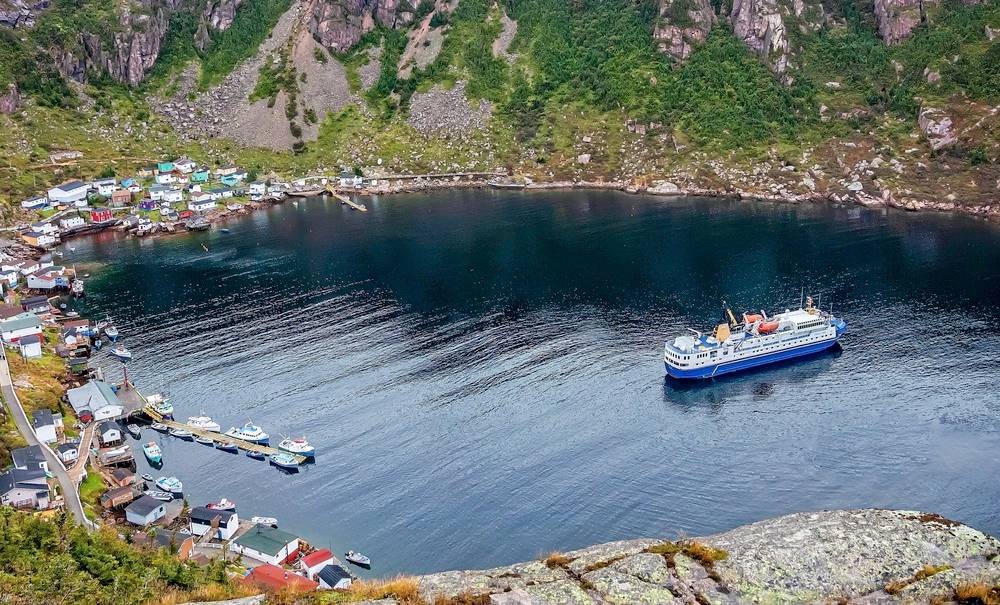
Follow the Labrador Current along Newfoundland’s rugged northeast coast, where fishing villages cling to headlands shaped by wind and tide. Its cold waters once supported the greatest fishery in the world, king cod, drawing settlers to carve out lives along the rocky shores. These coastal communities, though ever adapting, still carry the imprint of their sea-going heritage. Out at sea, whales surface and seabirds wheel overhead, drawn by the nutrient-rich flow. Here, wild landscapes and enduring traditions meet, revealing a shoreline defined as much by people and history as by the restless sea itself. - Day 15September 30, 2028
Saint-John's, Newfoundland and Labrador, Canada
Old meets new in the province's capital (metro-area population a little more than 200,000), with modern office buildings surrounded by heritage shops and colorful row houses. St. John's mixes English and Irish influences, Victorian architecture and modern convenience, and traditional music and rock and roll into a heady brew. The arts scene is lively, but overall the city moves at a relaxed pace.For centuries, Newfoundland was the largest supplier of salt cod in the world, and St. John's Harbour was the center of the trade. As early as 1627, the merchants of Water Street—then known as the Lower Path—were doing a thriving business buying fish, selling goods, and supplying alcohol to soldiers and sailors.
About the Ship
Ocean Nova

- 79Guests
- 1992Launched
- 73 mLength
All ship facts
- Crew
- 32
- Speed
- 13 kts
- Width
- 11 m
- Currency on board
- USD
- Language
- en